
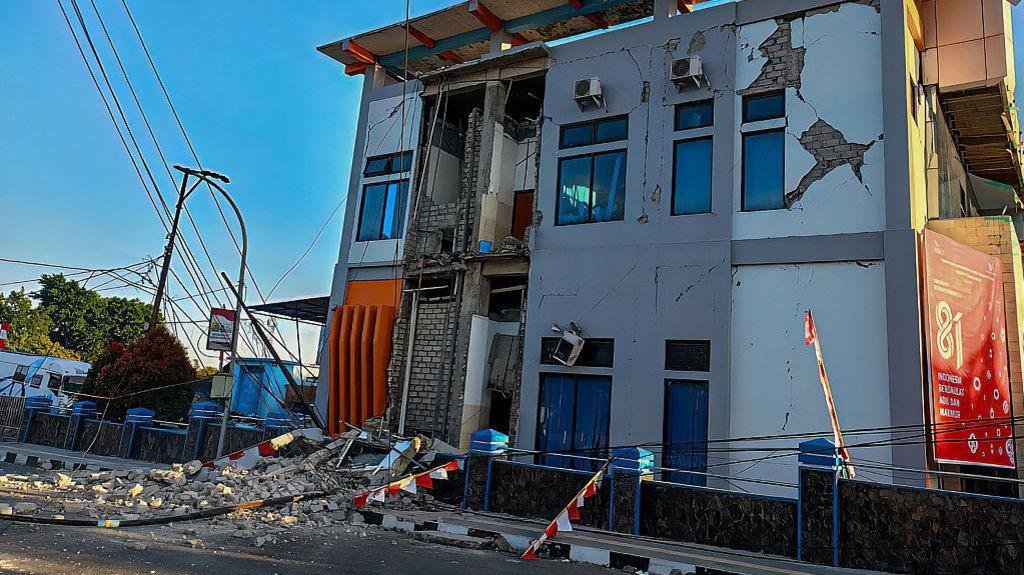
A powerful magnitude 7.7 earthquake struck off the northern coast of Flores Island in eastern Indonesia early Saturday morning. The violent shallow tremor collapsed hundreds of homes and damaged vital port and transport infrastructure. It killed at least 20 people while triggering widespread panic across East Nusa Tenggara province.
Early Morning Tremor and Tsunami Scare
The earthquake struck at 5:58 AM local time at a shallow depth of 10 kilometers. Its epicenter was located in the sea approximately 68 kilometers north-northwest of the town of Ende.
Because shallow earthquakes transfer more energy directly to the earth’s surface, violent shaking rattled communities across Flores, Sumbawa, and parts of South Sulawesi. Meanwhile, frightened residents fled their beds and poured into the streets as ground movement lasted nearly a minute.
Shortly after the main shock, Indonesia’s Meteorology, Climatology, and Geophysics Agency issued a high-level tsunami warning for coastal zones across East Nusa Tenggara, West Nusa Tenggara, and South Sulawesi. As a result, coastal communities fled toward elevated hills as sea levels fluctuated.
Emergency teams recorded localized tsunami waves of up to 0.94 meters near Maurole district before ocean conditions stabilized. The warning was officially cancelled nearly three hours later, allowing displaced residents to return cautiously to urban areas.
Heavy Casualties and Widespread Infrastructure Collapse
Search-and-rescue teams have confirmed at least 20 deaths spread across four major towns on Flores Island. Six individuals are hospitalized for severe injuries and several others are reported trapped beneath collapsed structures.
- Maumere Port Collapse: In the coastal town of Maumere, two people were killed and five others sustained critical injuries. This occurred when the roof of a maritime passenger terminal collapsed on waiting crowds.
- Residential & School Destruction: In East Manggarai and Manggarai regencies, falling roofs killed nine people. At St. Peter Major Seminary in Sikka, hundreds of students ran out into courtyard spaces in panic. Meanwhile, an assembly hall roof caved in, leaving a priest injured.
- Hospital Evacuations: Medical staff at regional hospitals in Sikka and Ende were forced to move patients outdoors into open parking lots. Doctors set up temporary treatment bays using outdoor cots, IV stands, and mobile oxygen tanks to care for incoming victims amid ongoing aftershocks.
- Airport & Transit Damage: Ceilings partially collapsed at Frans Sales Lega Airport in Ruteng. Major transit highways connecting Ende to Nagekeo and Maumere remain impassable due to fallen rock debris and wide road cracks.
Strong Aftershocks and Active Rescue Response
Seismologists have recorded multiple strong aftershocks following the primary quake, including tremors measuring 6.1 and 5.9 in magnitude.
The National Disaster Mitigation Agency along with local Basarnas search-and-rescue units are deploying boats and specialized heavy gear to access cut-off coastal settlements. Communications in these areas remain down.
Indonesia sits directly atop the Pacific “Ring of Fire,” an arc of intense fault lines where tectonic plates collide. The region off Flores Island carries a history of severe seismic activity. For example, a devastating 1992 earthquake and tsunami claimed over 2,500 lives along the same coastline.
Disaster officials have urged citizens to stay out of compromised concrete structures as search teams continue clearing rubble.

Curated news reports, in-depth analysis, and special features by India’s Opinion editorial team.