
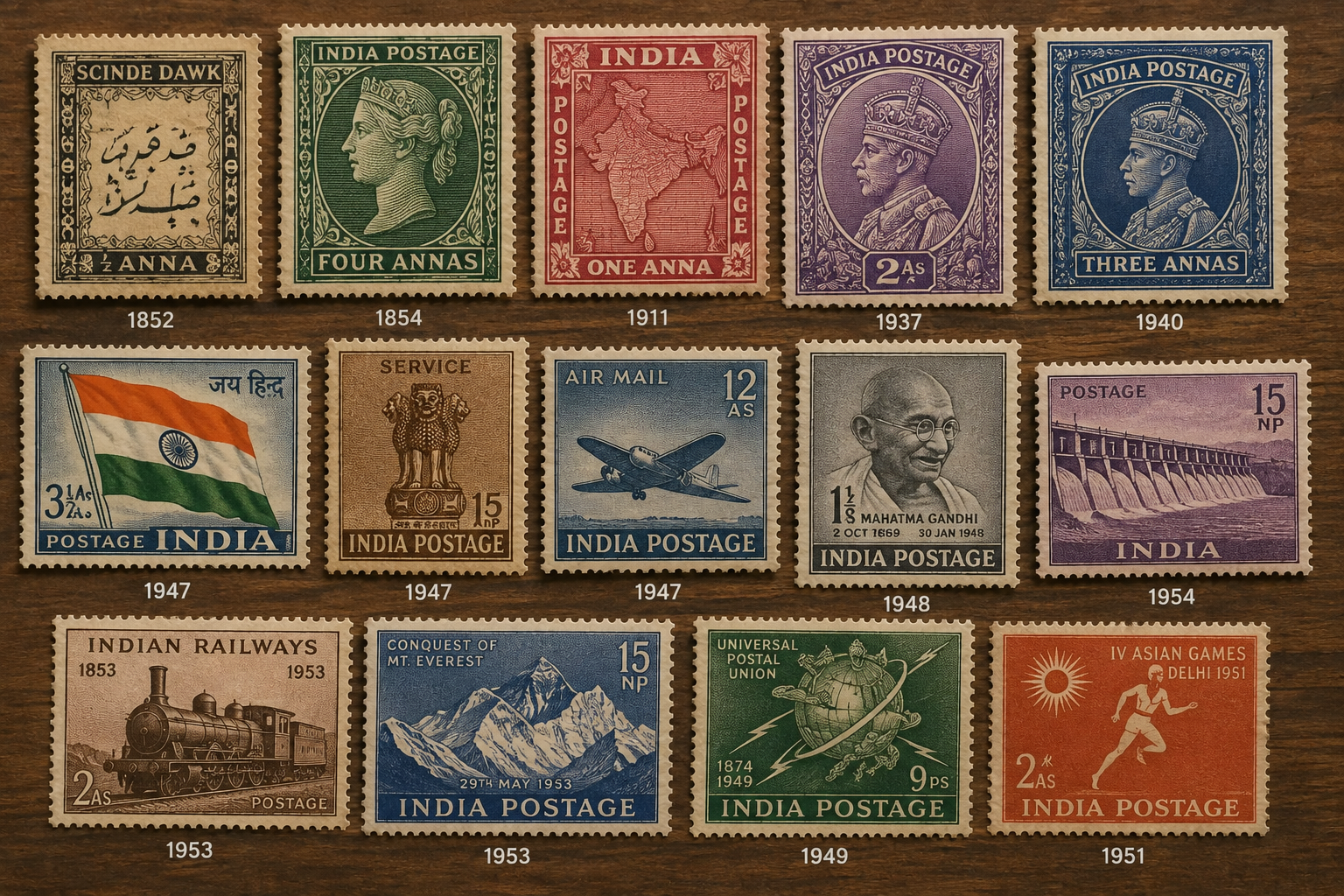
A tiny piece of paper can preserve a country’s history for generations. Indian postage stamps have done exactly that, recording political change, national figures, scientific achievements, cultural traditions and major events since the 19th century.
Long before smartphones and instant messaging, stamps helped connect people across vast distances. They also became miniature works of public art. India Post describes philately as a way to explore the country’s historical and cultural heritage through stamps.
The story of Indian stamps begins before independence. Their development followed the expansion of India’s organised postal system and later reflected the emergence of an independent republic.
Indian postage stamps began with the Scinde Dawk
The history of Indian postage stamps reaches back to 1852, when the first adhesive postage stamp in Asia was issued in the Sindh region, then known as the Scinde province.Known as the Scinde Dawk, the stamp marked an important stage in the development of organised postal communication.
India Post records that these stamps remained in circulation until June 1866.The postal system itself had much older roots.
India Post’s historical timeline records postal arrangements involving horse and foot carriers centuries before the introduction of adhesive stamps. Sher Shah also established a horse-based postal route between Bengal and Sindh in the 16th century.
The introduction of postage stamps therefore did not create India’s postal network. Instead, it helped modernise and standardise a system that had evolved over centuries.
The 1854 stamps changed postal communication
A major development came in 1854. India Post identifies October 1, 1854, as the date when the first postage stamp valid across India was issued.The new system introduced a more uniform approach to postage based on weight. It made postal communication more accessible and helped create a more integrated postal network.
The period also saw wider institutional changes. Calcutta’s General Post Office had opened in 1774, followed by Madras in 1786 and Bombay in 1794.
These developments laid important foundations for the modern postal system.By the late 19th century, the postal network had expanded considerably.
India joined the Universal Postal Union in 1876, strengthening its connection with the international postal system.
Indian postage stamps after independence
Independence gave Indian postage stamps a new national purpose. The first stamp of independent India appeared on November 21, 1947.
The stamp carried an image of the Indian national flag and the words “Jai Hind”. It had a denomination of three and a half annas. India Post records it as the first postage stamp issued by independent India.Two more stamps followed in the first year of independence.
They featured the Ashoka Lion Capital and an aircraft, reflecting the new country’s national identity and aspirations.
These early issues show how quickly postage became part of India’s visual identity. The designs moved away from colonial symbolism and began presenting symbols associated with the new nation.
Mahatma Gandhi and the power of commemorative stamps
One of the most famous early examples came in 1948, when India issued a set of four stamps dedicated to Mahatma Gandhi.The Gandhi stamps carried denominations ranging from 1½ annas to Rs 10.
They became important philatelic pieces because they commemorated one of the central figures of India’s independence movement.Commemorative stamps gradually became a way for the government to honour people, institutions and events.
Their subjects expanded beyond political leaders to include writers, scientists, artists, athletes, social reformers and cultural traditions.This approach turned the stamp into more than proof of postage. Each issue could function as a small historical document.
Indian postage stamps became miniature history books
The range of subjects appearing on Indian postage stamps grew rapidly after independence.India Post’s catalogue records stamps commemorating the Republic of India, the Asian Games, India’s railway history, the conquest of Mount Everest, the telegraph and the Universal Postal Union.
A 1952 series, for example, honoured Indian saints and poets. The stamps featured Kabir, Tulsidas, Mirabai, Surdas, Mirza Ghalib and Rabindranath Tagore.The following year, stamps marked the railway centenary and the successful ascent of Mount Everest.
Such issues reflected the country’s interest in both cultural heritage and modern achievements.The choices also reveal how governments use public imagery to tell stories about national identity.
Art and design behind Indian stamps
The appeal of Indian postage stamps extends beyond their historical information. Their small size requires designers to communicate a subject through carefully selected images, lettering and colour.A successful stamp has to remain recognisable at a very small scale.
Portraits, monuments, animals, landscapes and cultural symbols must fit into a limited space without losing their identity.This has made Indian stamps attractive to collectors and researchers.
India Post’s philately service describes stamps as objects with historical, cultural and artistic value, while also noting that their collectible value can differ substantially from their original postal value.That distinction matters for collectors. A stamp’s original denomination does not necessarily determine its value decades later.
Why people still collect Indian stamps
Stamp collecting, or philately, has survived despite the decline of traditional letter writing.Collectors study stamps for many reasons.
Some focus on particular historical periods. Others collect themes such as wildlife, architecture, freedom fighters, sports, science or Indian art.For researchers, stamps can provide visual evidence of how governments presented national achievements and cultural figures at different points in history.
India Post continues to maintain philately services and promotes stamps as a gateway to the country’s heritage.
Indian stamps in the digital age
The role of Indian postage stamps has changed as communication has moved online. Letters no longer dominate everyday communication in the way they once did.
Yet India’s postal system remains enormous. India Post says the Department of Posts operates more than 155,000 post offices, making it the world’s most widely distributed postal network.That scale explains why the stamp has not disappeared.
Postal communication has changed, but the institution behind it continues to serve millions of people.Modern postal services now include parcels, financial services, insurance and digital systems alongside traditional mail.
The stamp therefore exists within a much larger communications network than the one that produced the Scinde Dawk.
The legacy of Indian postage stamps
The history of Indian postage stamps is ultimately a history of communication, identity and memory.From the Scinde Dawk of 1852 to the first national issues after independence and later commemorative designs, stamps have recorded the changing priorities of the country. They have celebrated leaders, artists, scientific progress, sporting achievements and cultural traditions.
Their importance goes beyond the cost printed on them. A stamp can show how a period wanted to represent itself, what achievements it chose to celebrate and which figures it wanted future generations to remember.As physical letters become less common, that historical role may become even more valuable.
The postal stamp that once helped carry a message across India now carries something else too: a small, enduring record of the country through time.

Umar Khan is a writer driven by curiosity and a passion for understanding the world. Through thoughtful analysis and evocative storytelling, he seeks to make complex ideas accessible, inspire meaningful conversations, and encourage fresh perspectives on the people, places, and issues that shape our shared future.