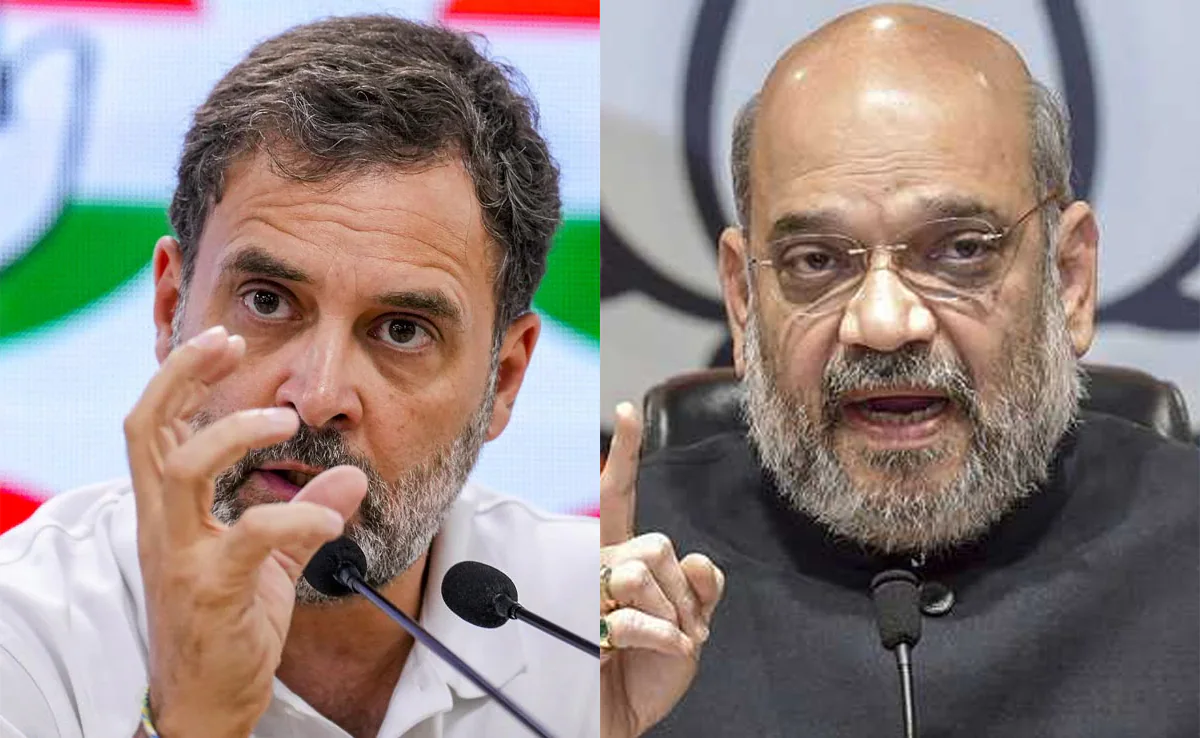
Dharmendra Pradhan’s resignation hasn’t ended the standoff in Parliament. Instead, it has simply shifted its target. With the Education Minister gone, the Opposition is now turning its fire on Union Home Minister Amit Shah over alleged police excesses during the July 20 march to Parliament.
Opposition leaders meeting at Rajya Sabha Leader of the Opposition Mallikarjun Kharge’s chamber on Monday decided to stall proceedings and demand a statement from Shah, sources said. The crackdown on protesters marching toward Parliament that day has come under sustained scrutiny. Additionally, pellet gun use is emerging as the central flashpoint.
Rahul Gandhi’s letter to the Home Minister
Lok Sabha Leader of the Opposition Rahul Gandhi had already signalled where this was headed. In a letter to Shah, Gandhi wrote that students demanding a fair and accountable education system were instead met with “indiscriminate force, including lethal weapons and tear gas.”
Even as CJP called off its protest on Sunday, Gandhi reiterated the Opposition’s two remaining demands: an apology from Prime Minister Narendra Modi, and accountability from Shah. He also wrote, “Hundreds have suffered serious injuries. Women students have been assaulted by policemen, including by deliberately targeting their private parts. Most shocking has been the use of lethal pellet guns.”
Citing media and social media reports, Gandhi said several people, including a journalist, suffered grave injuries. He asked whether Shah had personally sanctioned the use of pellet guns. Further, he asked whether plainclothes personnel had been deployed to assault protesters.
“I met 19-year-old student Sahil Lochab, who is now in severe pain (and) is likely to lose an eye because he was shot with pellet guns. Security forces deployed in Delhi answer ultimately to [Shah],” Gandhi wrote, arguing that peaceful protest is essential to any democracy. He added that the government’s duty is to protect protesters, not confront them.
“As Home Minister, did you approve the use of lethal force, including pellet guns, against students? If not, who did? Are the people in plain clothes seen beating students with lathis police personnel or volunteers? Who authorised their deployment?” he asked.
How the Opposition plans to force the issue
According to sources, several Opposition parties, including Congress, TMC and CPI(M), have drafted notices under Rule 267 seeking suspension of business to discuss the authorisation of “lethal weapons” against students. The Samajwadi Party is likely to join as well. A final call is expected at Monday’s floor leaders’ meeting.
“We will insist on answers from Amit Shah when Parliament meets on Monday. The country needs to know who authorised the use of a semi-lethal weapon like the pellet gun,” an Opposition MP said.
A senior Congress MP involved in the party’s Parliament strategy said the CJP calling off its protest wouldn’t change the Opposition’s approach. “While the CJP may have ended the protest, we will continue to take this fight forward against the government. The PM should apologise and the Home Minister should answer the questions of Parliament,” the MP said. They added that answers would be sought “not just from the government at large, but directly from the Home Minister and PM.”
CPI(M) leaders confirmed the party would file its own adjournment motion. “The Home ministry controlled everything that happened and the Home minister should answer questions as he is directly culpable,” a party leader said.
The scale of the crackdown on July 20 is what’s driving the demand for answers. Sahil Lochab, 19, suffered pellet injuries on the right side of his body. A 28-year-old sports journalist sustained injuries from what was described as a physical assault by pellet gun at Jantar Mantar. Both cases have become central to the Opposition’s case that the force used went well beyond standard crowd control.
Two bills, one confrontation
The timing adds another layer of pressure. Parliament is due to take up two significant pieces of legislation in the coming days: the Public Examinations (Prevention of Unfair Means) Amendment Bill, 2026, and the Prevention of Insults to National Honour (Amendment) Bill, 2026. The anti-paper-leak bill proposes a minimum five-year jail term, which can be extended to 10 years. It also stipulates a fine of up to Rs 50 lakh for individuals involved in paper leaks. For organised crimes, there is a minimum seven-year sentence and fines up to Rs 10 crore.
Whether the Opposition’s push to corner Shah disrupts debate on both bills, or runs alongside it, will depend heavily on what the government agrees to concede once the House reconvenes.
Monday’s floor leaders’ meeting will settle the Opposition’s exact strategy, but the direction is already clear. Having secured Pradhan’s exit, the Opposition sees an opening to press further, directly at the Home Ministry, on a question the government has yet to answer publicly. How the Chair handles the Rule 267 notices, and whether the government offers any statement from Shah before disruption becomes the default mode again, will shape the next stretch of the Monsoon Session.

Curated news reports, in-depth analysis, and special features by India’s Opinion editorial team.