
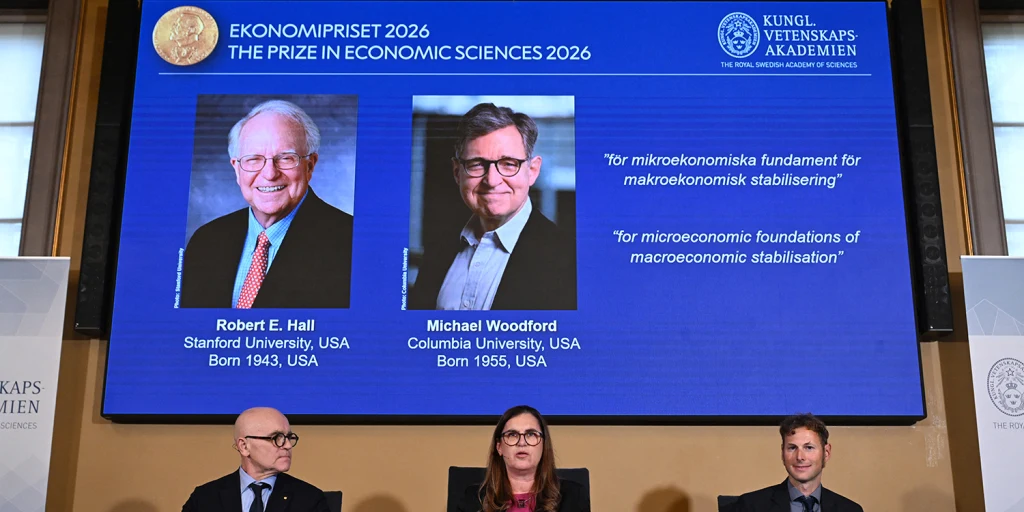
American economists Robert E. Hall and Michael Woodford won the 2026 Nobel Memorial Prize in Economic Sciences on Monday. The Royal Swedish Academy of Sciences in Stockholm announced the prestigious honor. The committee awarded the prize for their groundbreaking work on the microeconomic foundations of macroeconomic stabilization.
The prestigious award carries a cash prize of 12 million Swedish kronor. The two laureates will share the purse equally. According to official award citations reported by The Guardian, their findings transformed how governments manage economic booms and busts. Therefore, their mathematical frameworks help central banks prevent prolonged recessions and control runaway price inflation.
Robert Hall’s Breakthroughs in Household and Labor Dynamics
Robert E. Hall serves as a prominent professor of economics at Stanford University. His pioneering research explored how individual households make consumption and spending choices over time. Hall demonstrated that consumers adjust spending based on long-term income expectations rather than temporary windfalls.
Furthermore, Hall uncovered critical insights into labor market behavior and wage rigidity. As detailed by The Japan Times, he showed why wages often adjust slowly during severe economic downturns. Consequently, his models explained why companies freeze hiring instead of immediately lowering existing worker pay. This breakthrough provided economists with reliable microeconomic tools to understand nationwide unemployment trends.
Michael Woodford’s Blueprint for Modern Central Banking
Michael Woodford serves as a leading macroeconomic theorist at Columbia University. His landmark studies laid the cornerstone for New Keynesian macroeconomics. Woodford authored the influential 2003 work Interest and Prices, which revolutionized monetary theory.
The Columbia scholar proved that central banks steer economies primarily by guiding public expectations. Furthermore, he established the analytical foundations for modern “forward guidance.” He showed that clear central bank communication shapes long-term interest rates far more effectively than short-term cash adjustments alone. As a result, monetary authorities gained precise scientific tools to manage inflation targets.
Revolutionizing Global Monetary and Inflation Policy
The combined research of Hall and Woodford created a lasting paradigm shift in global economic governance. Central banks, including the US Federal Reserve, European Central Bank, and Reserve Bank of India, now rely heavily on their models.
These quantitative frameworks guide policymakers when adjusting benchmark borrowing rates during financial shocks. Meanwhile, finance ministries use their stabilization principles to balance fiscal spending during inflationary surges. On the other hand, traditional economic models struggled to connect individual decisions with broad national growth. Moreover, the Nobel committee affirmed that Hall and Woodford gave humanity a dependable roadmap for financial stability.

Curated news reports, in-depth analysis, and special features by India’s Opinion editorial team.