
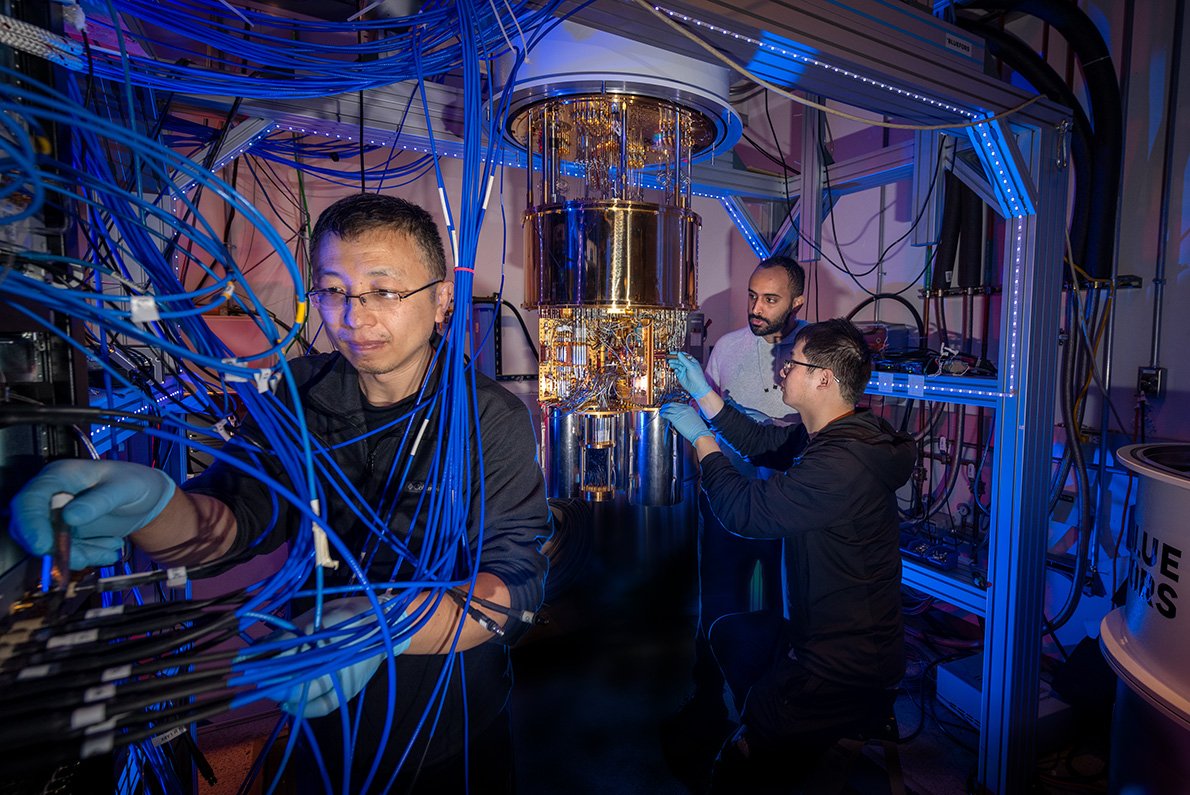
The race to build a faster and more secure internet has entered a new phase. Governments, universities, and technology companies are investing heavily in Quantum internet technology. Researchers believe the new approach could redefine digital communication by allowing data to travel with a level of security that traditional networks cannot easily match. While large scale deployment remains years away, recent experiments suggest that the field is moving from theory toward practical application.
Unlike the conventional internet, which relies on electrical and optical signals, Quantum internet technology uses the principles of quantum physics. Scientists transmit information through quantum bits, also called qubits. These qubits behave differently from ordinary binary data. Their unique properties make it possible to detect any attempt to intercept information during transmission.
Why Quantum Internet Technology Matters
Cybersecurity has become one of the biggest concerns for governments and businesses. Financial institutions, healthcare providers, and defense organizations face increasingly sophisticated cyberattacks. Quantum internet technology offers a different approach by making communication inherently secure instead of relying only on complex encryption methods.
Researchers often point to quantum key distribution as one of the first practical applications. The technique allows two parties to exchange encryption keys with built in protection against eavesdropping. If someone attempts to intercept the transmission, the quantum state changes immediately, alerting both users.
Countries Accelerate Research
Several countries have expanded funding for quantum research during the past decade. The United States, China, members of the European Union, Japan, Canada, and India have launched national initiatives to strengthen quantum science. Public funding has also encouraged partnerships between universities and private companies.
China has already demonstrated long distance quantum communication through satellite experiments. European researchers continue to develop cross border quantum communication networks. In the United States, federal agencies support multiple research centers that study secure quantum networking. These efforts show that Quantum internet technology has become an international scientific priority.
India’s Growing Role in Quantum Internet Technology
India has also increased investment in quantum research through the National Quantum Mission. The initiative supports work in quantum communication, quantum computing, sensing, and advanced materials. Indian Institutes of Technology, the Indian Institute of Science, and several research laboratories are developing technologies that could strengthen future communication infrastructure.
Experts believe India can build domestic expertise by combining academic research with industrial collaboration. Success will depend on skilled researchers, long term investment, and strong manufacturing capabilities.
Challenges Remain Before Commercial Use
Despite recent progress, scientists acknowledge that major technical barriers remain. Quantum signals weaken over long distances. Researchers continue to improve quantum repeaters, specialized devices that extend communication without compromising security.
Building reliable quantum hardware also presents engineering challenges. The equipment often requires highly controlled environments and precise calibration. Costs remain high, which limits commercial deployment at present. These obstacles explain why Quantum internet technology is still in the research and pilot stage rather than everyday use.
Industries That Could Benefit
Banks could protect financial transactions more effectively. Hospitals may secure sensitive medical records. Governments could strengthen classified communications. Scientific institutions may share research data with greater confidence. Critical infrastructure operators could also reduce the risk of cyber intrusion.
Technology companies are exploring ways to combine classical networks with quantum communication instead of replacing today’s internet entirely. Many experts expect hybrid systems to appear before fully quantum networks become common.
What Experts Say
Scientists generally agree that quantum communication represents one of the most promising areas of modern physics. At the same time, they caution against unrealistic expectations. A global quantum internet will require international standards, compatible hardware, and years of infrastructure development.
Research published in leading scientific journals, including Nature and Science, has demonstrated steady progress. Government agencies such as the U.S. National Institute of Standards and Technology, the European Commission, and India’s Department of Science and Technology continue to support research in this field.
The Road Ahead for Quantum Internet Technology
The coming decade will determine whether laboratory breakthroughs can evolve into practical communication networks. Researchers are expected to conduct more long distance trials, improve hardware reliability, and reduce deployment costs. If these goals are achieved, Quantum internet technology could become one of the most important advances in digital communication, changing how governments, businesses, and individuals protect information in an increasingly connected world.

Curated news reports, in-depth analysis, and special features by India’s Opinion editorial team.