
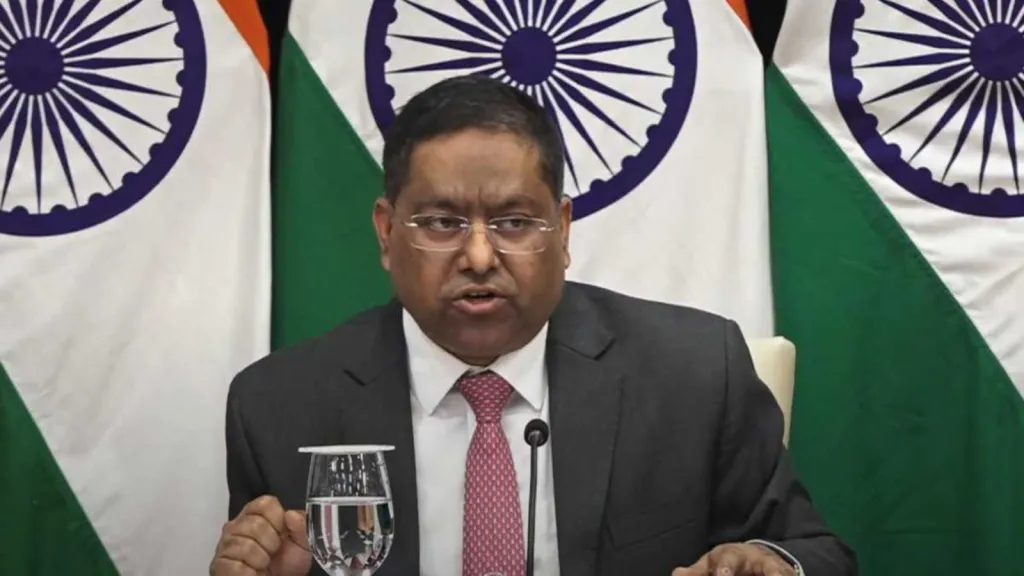
India strongly countered Chinese objections regarding the Union Territory of Ladakh on Tuesday. The Ministry of External Affairs (MEA) asserted that Ladakh remains an integral and inalienable part of India. The diplomatic rebuttal responded directly to critical statements issued by the Chinese foreign ministry in Beijing.
MEA official spokesperson Randhir Jaiswal dismissed China’s territorial claims during an official media briefing. According to official diplomatic statements published by The Hindu, Jaiswal stated that external denial cannot alter established geopolitical facts. Therefore, New Delhi reaffirmed its complete constitutional and sovereign authority over the northern frontier territory.
Survey of India Standardizes 28 Strategic Border Points
The diplomatic friction flared after India formalized official names for 28 geographical locations across Ladakh. The Ministry of Home Affairs published the updated Survey of India map earlier this month. The approved list standardizes names for ten mountain peaks, two high-altitude passes, and two glaciers.
The gazette also covers key friction points along the Line of Actual Control (LAC), including Gogra and Hot Springs. As detailed by Hindustan Times, the mapping initiative involved close consultations with local hill councils. Furthermore, Indian officials explained that standard geographical names improve administrative tracking and emergency relief coordination. Consequently, the central government described the cartographic project as a routine domestic exercise.
China Claims Naming Drive Violates Western Border Status
In Beijing, Chinese foreign ministry spokesperson Mao Ning criticized India’s mapping notification during a regular press conference. She asserted that China does not recognize the Union Territory of Ladakh established in 2019. Mao termed India’s decision to publish standardized names as unlawful and invalid.
The Chinese spokesperson claimed that standardizing geographical features alters the disputed status of the western border. However, the Indian government firmly rejected Beijing’s arguments as groundless interference. In an official communication released by the Ministry of External Affairs, New Delhi reiterated that domestic administrative decisions remain sovereign Indian prerogatives. As a result, India dismissed China’s protests as baseless posturing.
Diplomatic Counter Against Recurring Cartographic Battles
The dispute reflects broader ongoing naming disagreements along the disputed Himalayan border. China has repeatedly attempted to assign invented Mandarin names to villages across Arunachal Pradesh. New Delhi has consistently dismissed those naming drives, noting that renaming sovereign Indian territory cannot change ground reality.
Meanwhile, military commanders from both sides continue diplomatic discussions to maintain peace along patrolling sectors. On the other hand, security analysts observe that infrastructure development continues steadily across eastern Ladakh valleys. Moreover, India maintains that stable bilateral relations require mutual respect for territorial sovereignty. Therefore, New Delhi made clear that Chinese verbal denials will not impede domestic governance in Ladakh.

Curated news reports, in-depth analysis, and special features by India’s Opinion editorial team.