Dramatic scenes unfolded across the national capital on Tuesday as the opposition INDIA alliance launched its nationwide march toward the Election Commission headquarters. Delhi Police deployed heavy barricades and anti-riot units to block the procession near the Mandi House hub.
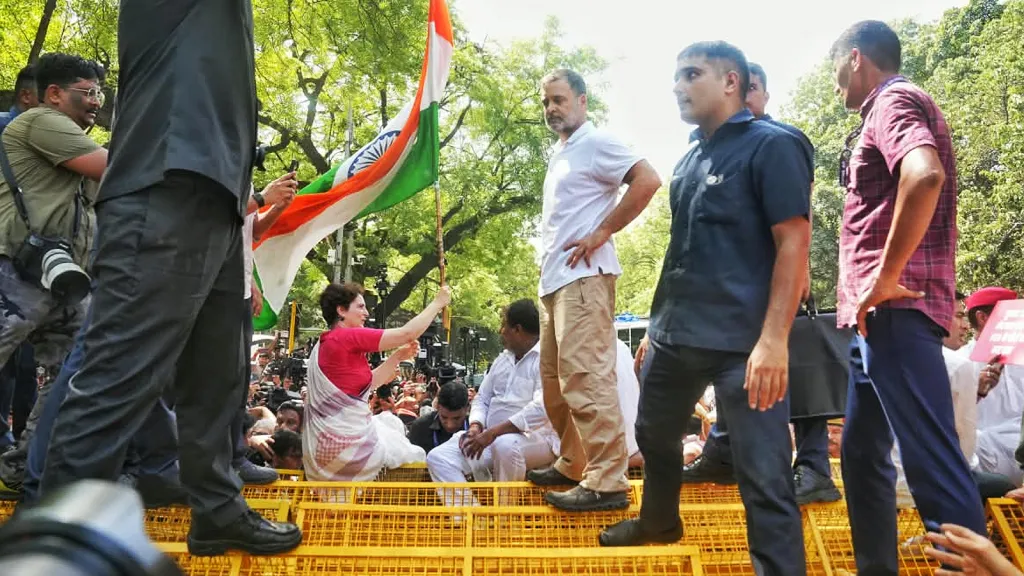
Prevented from marching toward Nirvachan Sadan, Leader of Opposition Rahul Gandhi and Congress MP Priyanka Gandhi Vadra sat down on the road right outside the Doordarshan Bhawan gates. Furthermore, their impromptu sit-in triggered an intense standoff with police personnel, according to live reports by India Today.
Barricades Block Opposition March to Election Commission
The confrontation began shortly after senior parliamentarians assembled at the central party offices to begin their “Save Democracy” march. The coalition organized the march to demand the resignation of Chief Election Commissioner (CEC) Gyanesh Kumar over controversial voter roll revisions.
However, Delhi Police had already sealed Ashoka Road and Copernicus Marg with multi-tiered iron barricades and shipping containers. When the marching leaders reached the Doordarshan roundabout, security forces halted their advance.
Scuffles broke out as demonstrators pushed against police cordons. Rahul Gandhi briefly climbed atop a security barricade to address the crowd, urging citizens to defend constitutional voting rights, as detailed by The New Indian Express.
Spontaneous Sit-In Stalls Central Delhi Corridors
Refusing to turn back, Rahul Gandhi, Priyanka Gandhi Vadra, and dozens of opposition MPs sat on the tarmac outside the Doordarshan building. Holding pocket copies of the Constitution of India, leaders began chanting protest slogans against the poll panel.
Priyanka Gandhi Vadra addressed reporters from the protest site, accusing authorities of misusing administrative power to muzzle peaceful dissent. She argued that elected parliamentarians hold a constitutional right to submit public grievances to the election watchdog.
Meanwhile, police officers used megaphones to announce that Section 163 of the Bharatiya Nagarik Suraksha Sanhita (BNSS) remains strictly enforced across the district, prohibiting street assemblies, according to coverage by The Daily Pioneer.
Heavy Security Deployment and Transit Curbs
The roadside dharna quickly drew hundreds of party volunteers and student activists to the surrounding streets. Consequently, traffic came to a standstill across the central administrative corridor connecting Mandi House and India Gate.
Police deployed water cannons, tear gas vehicles, and rapid deployment battalions to isolate the gathering. In addition, the Delhi Metro Rail Corporation temporarily closed several station gates around Patel Chowk and Central Secretariat to manage crowds.
After nearly two hours of tense negotiations, police personnel began detaining protesters and escorting senior leaders onto transport buses for removal to local police stations.
A Rising Political Battle Over Electoral Trust
The roadside confrontation outside the Doordarshan office marks the highest point of political friction between the unified opposition and the election regulator.
The demonstration occurred just twenty-four hours after the Supreme Court pulled up the Election Commission for altering voter registration templates without judicial approval. With both street protests and court battles escalating simultaneously, the fight over electoral transparency is dominating the national agenda.
Ultimately, Tuesday’s dramatic face-off shows that the opposition intends to maintain relentless pressure on the government until the election body restores full institutional transparency.

Curated news reports, in-depth analysis, and special features by India’s Opinion editorial team.