
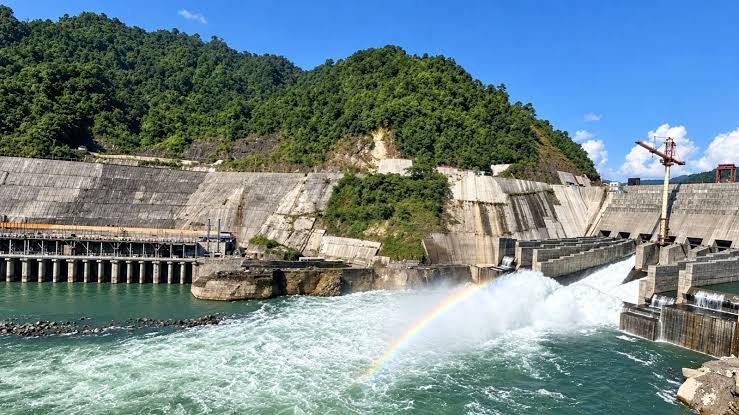
State-run hydro power major NHPC Limited has sought formal forest clearance to clear over 23 lakh trees in Arunachal Pradesh. The massive tree felling is required to build the 1,720-megawatt (MW) Kamala Hydroelectric Project. The proposed mega dam will sit across the pristine Kamala River, a primary tributary of the Subansiri basin.
The project requires diverting approximately 3,278 hectares of dense subtropical and temperate forest land. According to official environmental appraisal documents published by The Indian Express, the project affects Kamle, Kra Daadi, and Kurung Kumey districts. The Union government previously cleared the project’s investment budget of Rs 26,069 crore. Therefore, the state utility now awaits statutory environmental approvals to begin civil earthworks.
Forest Advisory Committee Scheduled to Review Clearance on October 23
The Forest Advisory Committee (FAC) under the Union Ministry of Environment, Forest and Climate Change will review the proposal on October 23. The expert committee will examine the project’s biodiversity impact assessment and local tribal resettlement plans.
The developer has requested Stage-I in-principle approval to initiate forest land acquisition. As documented by the Press Information Bureau, the dam forms a central pillar of India’s clean energy transition. The reservoir will generate over 6,700 million units of green electricity annually once fully commissioned. Consequently, energy planners consider the project critical to balance expanding national electricity grids with zero-emission generation.
Out-of-State Afforestation Sparks Ecological Backlash
Environmental activists and indigenous tribal groups have raised serious alarms over the staggering scale of canopy destruction. The submergence zone will destroy virgin habitat supporting rare Himalayan wildlife, including clouded leopards and hornbills.
Furthermore, conservationists strongly criticized the developer’s compensatory afforestation blueprint. Because mountainous Arunachal Pradesh lacks non-forest land, officials proposed planting replacement saplings thousands of kilometers away in central India. Detailed ecological analysis by EastMojo highlighted that distant plantation drives cannot replace old-growth Himalayan ecosystems. In addition, local Nyishi tribal communities fear losing ancestral community hunting corridors and sacred riverbanks. As a result, grassroots civil society groups have submitted representations urging the ministry to reconsider the massive forest clearance.
Strategic Power Goals Clash With Downstream Flood Risks
The proposed dam also revives intense downstream safety debates across the neighboring Assam plains. Riparian communities along the lower Brahmaputra valley expressed worry over river flow fluctuations and flash flood risks during peak monsoon months.
Moreover, the Eastern Himalayas remain an active seismic zone vulnerable to massive landslides. On the other hand, central power administrators emphasized that modern dam designs include robust flood cushion reservoirs and earthquake-resistant structures. In addition, the central government promised substantial infrastructural royalties and regional job quotas to project-affected families. The upcoming decision by the Forest Advisory Committee will signal how the government balances aggressive green energy targets against sensitive biodiversity conservation.

Curated news reports, in-depth analysis, and special features by India’s Opinion editorial team.