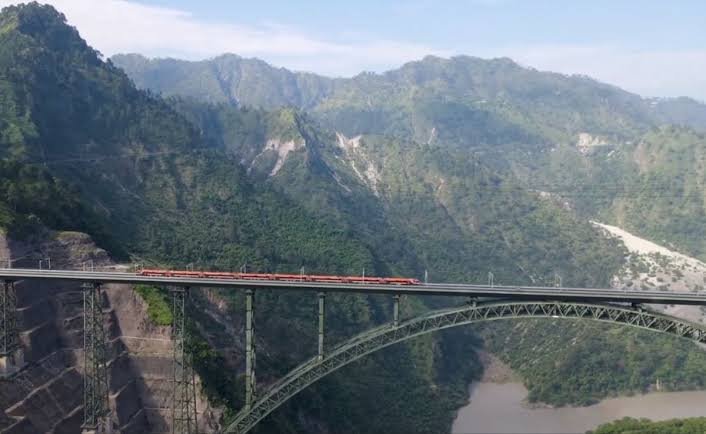
Indian Railways achieved a landmark engineering milestone on Friday as the Jammu–Srinagar Vande Bharat Express clocked a top speed of 100 kmph across the Chenab and Anji bridges. The high-speed test marks the first time a passenger rake crossed both mega-structures at full operational speed.
The achievement follows safety clearances from Northern Railway and the Railway Board. Authorities recently raised the maximum permissible speed on the critical 111-km Katra–Banihal section from 75 kmph to 100 kmph, according to a report by The Indian Express.
Crossing the World’s Highest Railway Bridge
The Chenab Rail Bridge stands 359 meters above the riverbed, soaring 35 meters higher than Paris’s Eiffel Tower. Crossing the massive steel arch at 100 kmph demonstrates the extraordinary structural stability of the track.
Engineers fitted the bridge with advanced seismic sensors and wind-monitoring systems. Consequently, the track absorbed the dynamic vibrations smoothly as the semi-high-speed rake sped across the gorge.
Furthermore, rail officials confirmed that the test produced zero structural deviations, validating the specialized track-laying technology used in the Himalayan terrain, as highlighted by NDTV.
Flawless Run Across the Cable-Stayed Anji Bridge
Moments later, the Vande Bharat train powered across the Anji Khad Bridge at the same 100 kmph pace. The 725-meter-long structure serves as India’s first cable-stayed railway bridge.
Ninety-six high-tension cables support the single central pylon rising from a steep gorge. In addition, specialized shock absorbers cushion heavy trains against sudden alpine crosswinds.
The test verified that the cable network maintains flawless track geometry even during high-speed braking and acceleration. Therefore, the successful trial clears the path for daily passenger express services at elevated speeds.
Slashing Travel Time Across the Kashmir Valley
The Katra–Banihal link forms the most complex segment of the ₹37,000-crore Udhampur–Srinagar–Baramulla Rail Link (USBRL) project. The route cuts through rugged Himalayan mountain ranges using 36 tunnels, including the 12.7-km Tunnel T-50.
Raising the track speed limit to 100 kmph drastically reduces transit times between Jammu and Srinagar. Meanwhile, passengers will travel in climate-controlled comfort without worrying about winter snow blockages along national highways.
As a result, regular Vande Bharat services will soon complete the journey in under three and a half hours, revolutionizing regional transport.
A Giant Leap for National Integration
This successful high-speed run completes decades of complex railway engineering in Jammu and Kashmir.
All-weather rail connectivity will spur tourism, boost local handicrafts, and speed up fresh produce deliveries from orchards to northern retail hubs. In addition, the seamless link strengthens national logistics to strategic border frontiers.
Ultimately, seeing the Vande Bharat glide across the clouds at 100 kmph showcases the finest achievements of modern Indian infrastructure.

Curated news reports, in-depth analysis, and special features by India’s Opinion editorial team.