The 20th Asian Games officially opened in Nagoya, Japan, on Saturday, bringing together more than 11,000 athletes from 45 countries and regions for one of the world’s largest multi-sport competitions.
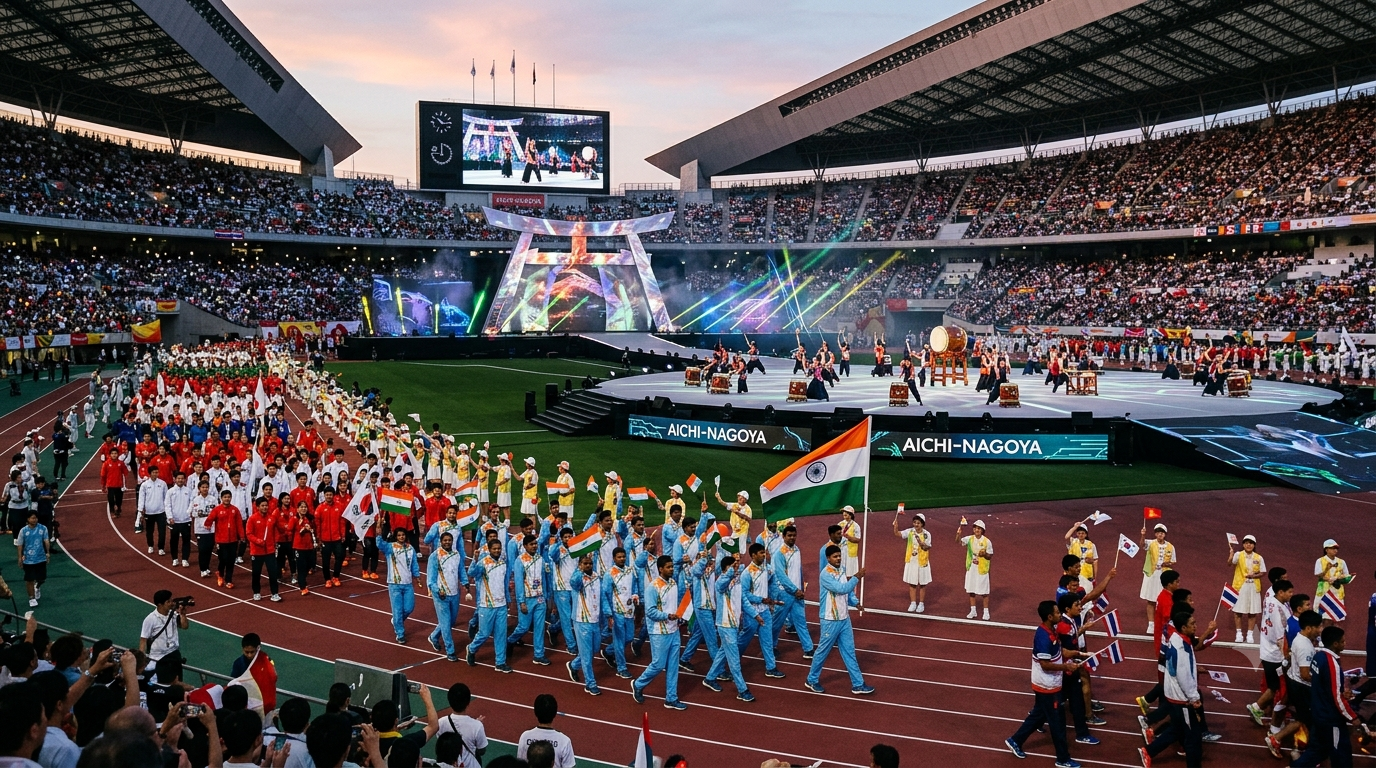
Japan’s Emperor Naruhito formally declared the Games open during a colourful ceremony at the Nagoya City Mizuho Park Athletic Stadium. The ceremony combined Japanese cultural performances with technology and industrial elements.
The Aichi-Nagoya Asian Games will run until October 4, with athletes competing across 43 sports and 71 disciplines. There are 469 gold-medal events on the programme.
India Among the Major Contingents
India has sent a large delegation to the Games, with athletes competing across several sports.
Double Olympic medallist Manu Bhaker and kabaddi player Pawan Sehrawat led India’s contingent at the opening ceremony.
Sehrawat replaced shot-putter Tajinderpal Singh Toor as India’s male flag-bearer after Toor was unable to travel from his training base in time.
India arrives in Nagoya after recording its best-ever Asian Games performance in Hangzhou in 2023, where it won 107 medals, including 28 gold, 38 silver and 41 bronze.
Several Indian athletes have already begun competing because some events started before Saturday’s official opening.
43 Sports on the Programme
The 2026 Games feature several sports that were not part of the previous Asian Games programme.
Mixed martial arts, padel, surfing, virtual taekwondo and teqball are among the newer additions.
Esports and breaking also remain on the programme after appearing at recent Asian Games editions.
Some sports that featured previously have been removed, including chess, bridge, go, xiangqi, dragon boat racing and marathon swimming.
The Games will also have implications beyond Asian competition.
Events in sports including archery, hockey, sailing, squash, surfing, tennis and triathlon will provide qualification opportunities for the 2028 Los Angeles Olympics.
Games Spread Across Several Japanese Cities
Although Nagoya is the main host city, competitions are taking place across several locations in Japan.
Swimming events are being held at the Tokyo Aquatics Centre, while some football matches are taking place in Osaka and Shizuoka. Other competitions are spread across Aichi Prefecture.
The Games are expected to involve around 17,000 athletes and officials, according to Reuters, considerably more than the organisers originally planned for.
The increase in registrations has contributed to accommodation pressures.
Accommodation Issues During the Build-Up
The opening ceremony follows a difficult preparation period for organisers.
Unlike previous Asian Games, organisers decided not to construct a dedicated athletes’ village.
Instead, participants have been accommodated in hotels, temporary wooden-container facilities and a cruise ship.
The Olympic Council of Asia has defended the arrangements, saying the registered athletes and officials have been provided with Games-appropriate accommodation.
Some athletes and delegations, however, have raised concerns about accommodation and transport arrangements.
Reuters reported that organisers faced a series of operational problems before the Games, including accommodation and transport difficulties.
Officials have defended the cost-saving approach and the decision to avoid building infrastructure that could become underused after the event.
Competition Runs Until October 4
The Aichi-Nagoya Asian Games will continue for 16 days, with competitions taking place through October 4.
The event marks Japan’s third time hosting the Asian Games, after Tokyo hosted the second edition in 1958 and Hiroshima staged the Games in 1994.
For athletes, the Games provide opportunities for continental medals, international experience and, in selected sports, qualification pathways toward Los Angeles 2028.
With thousands of competitors now assembled across Japan, attention will shift from the opening ceremony to the medal competition beginning across the 43-sport programme.

Curated news reports, in-depth analysis, and special features by India’s Opinion editorial team.