
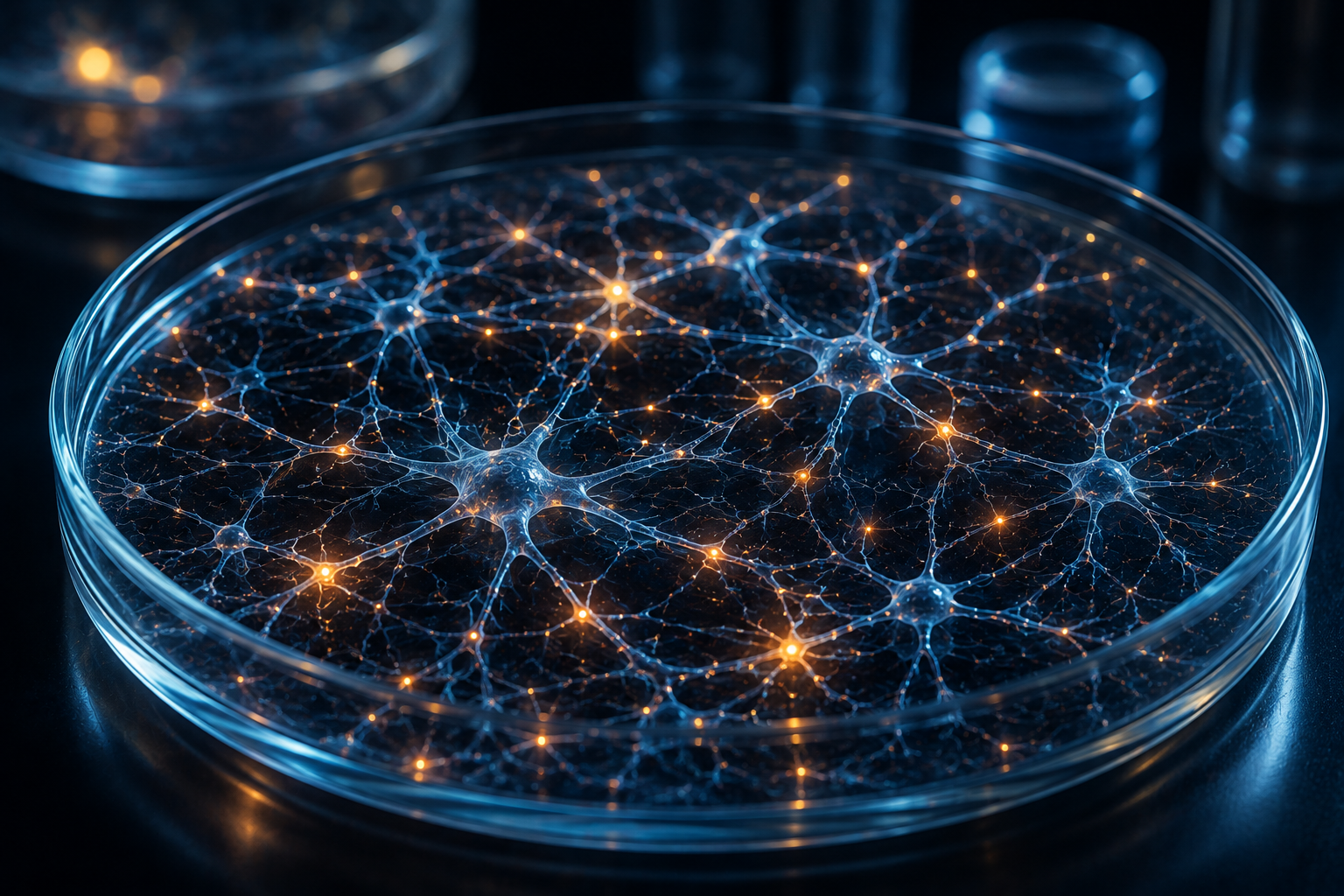
A tiny sample of your skin could, in theory, be turned into human brain tissue. It sounds far-fetched, but scientists have actually been doing versions of this for years.
Researchers can take adult human cells and reprogram them into induced pluripotent stem cells, or iPSCs. From there, those cells can be guided into becoming different types of cells, including neurons. Under the right conditions, the neurons organise themselves into three-dimensional structures called brain organoids.
Neurons are the brain’s basic working cells. They talk to each other using electrical and chemical signals, and that communication is what lets the brain process information. As a result, the brain can control everything from movement to memory.
Brain organoids are not miniature human brains. They lack the full structure and complexity of a real one. However, they reproduce enough features of a developing human brain to make them genuinely useful for studying how brains grow. This also helps with research into what goes wrong when disease sets in.
Here’s where it gets more interesting: these organoids aren’t just passive models sitting in a dish. They’re living, human-derived neural tissue, with neurons that connect, communicate and generate real electrical activity.
Why Scientists Are Growing Mini-Brains
Disease research is one major driver. Organoids let scientists study aspects of brain development and neurological disease that would be impossible, or unethical, to investigate inside a living human brain.
Researchers are already using these models to explore neurodevelopmental and neurological conditions, and to test potential treatments.
Drug testing is the other big use case. A drug that works in animal trials doesn’t always work in humans. Therefore, brain organoids give researchers a way to test how actual human-derived neural tissue responds to drugs and other substances. However, this does not replace animal research overnight.
But potentially reducing how much of it is needed by offering a more human-relevant model.
Funding is following the science. The US National Institutes of Health announced $87 million in September 2025 for a new Standardized Organoid Modeling Center. This center aims at building more reliable and reproducible organoid models.
It started with liver, lung, heart and intestine models, with plans to expand into the brain.
By March 2026, the NIH had committed more than $150 million toward human-based research. This research is designed to simulate human biology more accurately.
These Mini-Brains Are Doing Something
As neurons grow inside an organoid, they form networks and start communicating through electrical signals. Researchers can detect that activity, and even stimulate the neurons directly.
None of this means an organoid is thinking. But it does mean these small pieces of human neural tissue display some of the basic activity associated with a functioning brain.
The neurons connect, communicate, and respond when scientists stimulate them. As the networks mature, researchers observe increasingly organised patterns of activity.
In other words, scientists aren’t just growing a pile of human cells. They’re growing living neural networks and watching them develop and respond in real time.
Which raises an obvious next question: if living neurons can respond to information and adjust their behaviour based on what happens around them, could they also learn?
Along Came Pong
In 2022, researchers at Melbourne-based Cortical Labs decided to find out. They connected living human and mouse neurons to an array of electrodes. Then they placed them inside a simulated version of the classic video game Pong.
The question was simple but strange: could living brain cells be taught to play a game?
The system, called DishBrain, received information about the game through electrical signals. The neurons produced their own signals in response. When the system performed correctly, the neural culture got predictable feedback. But when it didn’t, the feedback turned chaotic.
According to the researchers, the neural cultures actually improved their performance over the course of the experiment. They described this as goal-directed activity, coining the term “synthetic biological intelligence” to describe it.
It’s worth being precise about what this was and wasn’t. This was not a miniature human brain sitting in a dish, consciously playing a video game. Instead, DishBrain was a layer of cultured neurons connected to electrodes, a biological neural network rather than a fully formed brain organoid.
The journal Neuron reported at the time that hundreds of thousands of human neurons growing on an electrode-covered dish had been taught to play a version of Pong.
What the experiment showed was that a network of living neurons could adapt its activity when connected to an environment that gave it information and feedback.
The researchers called that learning. But that doesn’t necessarily mean the neurons understood Pong, or that they were conscious in any meaningful sense.
Are These Mini-Brains Conscious?
The honest answer is that nobody really knows yet.
There’s no simple, universally accepted test that can look at a brain organoid and determine whether it’s conscious. Electrical activity alone doesn’t prove consciousness.
Neither does responding to a stimulus. And the fact that a neural culture appears to learn a simple task doesn’t prove it’s having any kind of subjective experience.
This remains an active area of scientific and ethical debate. A major 2024 review in Frontiers in Artificial Intelligence tackled exactly this territory: consciousness, moral status, informed consent, governance and regulation around brain organoids and what’s now called organoid intelligence.
This is where the science runs headlong into philosophy. If an organoid ever became complex enough to have some form of experience, how would anyone actually know? Right now, there’s no test that can answer that.
What Happens If Mini-Brains Get Bigger?
Brain organoids currently lack the full vascular system of a human brain. This makes it hard for larger structures to get enough oxygen and nutrients to survive.
Researchers are actively working on improving vascularisation to keep organoids alive longer and let them grow bigger.
The more sophisticated these systems get, the harder the ethical questions become. A tiny cluster of neural cells with limited activity is one thing.
A much larger, more mature, better-connected piece of human neural tissue is another question entirely. At what point would something like that deserve some form of protection?
That’s no longer a purely science-fiction question. Researchers and bioethicists are already discussing the potential moral status of brain organoids. In addition, they discuss issues of informed consent, privacy and regulation.
There’s also a more personal angle to this. A July 2026 commentary in Nature warned that people who donate tissue for biomedical research may not realise their cells could eventually be used to build biological computing systems.
That pushes the debate beyond whether a lab-grown brain deserves rights. It also raises the question of whether the person whose cells created it has any claim over what scientists eventually build from them.
When AI Meets Living Brain Cells
For years, the AI race has been about teaching machines to imitate how brains process information using silicon, software and artificial neural networks. Now, a small group of researchers is exploring something stranger: using actual living neural tissue as part of a computer.
The field has a name: organoid intelligence, or OI. A 2023 Frontiers paper that proposed the field described it as an approach combining brain organoids with technology that can send information to, and receive information from, living neural tissue.
The goal isn’t to replace AI with biological tissue outright. Instead, researchers want to explore whether biological neural networks could become another kind of computing system. These networks might work alongside conventional AI and electronics rather than against it.
Some researchers are already building around this idea. Cortical Labs has developed the CL1, a system it describes as a biological computer. This computer lets researchers use living neurons as a computing substrate, connecting neural cells directly with electronics and software.
The company has even demonstrated the classic shooter game Doom running on a CL1.
It’s still important to separate what’s real today from what remains speculation. Nobody has built a humanoid robot powered by a lab-grown human brain.
Nobody has created a conscious machine out of an organoid. What researchers have actually done is connect living neurons to electronic systems. They have also shown that those neurons can respond, adapt, and perform limited tasks.
The bigger open question is whether biological neural tissue could eventually become a genuinely useful new form of computing.
Researchers in this space point to potential advantages, like the ability of living neural systems to adapt and learn from relatively little data.
But it’s still a young field, and today’s systems are nowhere close to matching the flexibility and complexity of an actual human brain.
What Happens Next
A robot walking around with a lab-grown human brain still belongs firmly in the realm of science fiction. But the basic building blocks for something in that direction are quietly being assembled.
As the AI industry spends billions trying to engineer intelligence into machines, biologists are, in a real sense, growing the raw material of intelligence in petri dishes instead.
We’re likely still far from creating a conscious machine this way. But for the first time, the question of whether the next generation of computers might be built partly from the brain, rather than merely in imitation of it, is no longer purely hypothetical.

Curated news reports, in-depth analysis, and special features by India’s Opinion editorial team.