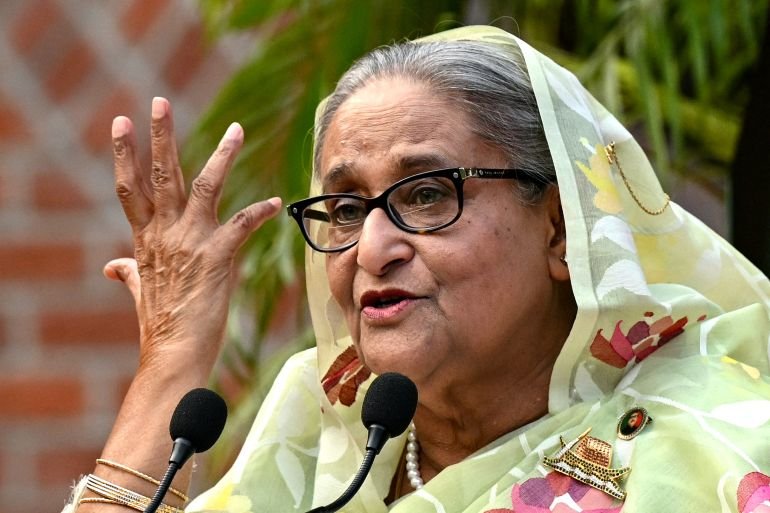
Former Bangladesh Prime Minister Sheikh Hasina has announced that she intends to return to Bangladesh in December. Despite facing a death sentence and the prospect of arrest upon arrival, she remains resolute. Her declaration has added a fresh layer of uncertainty to Bangladesh’s already polarised political landscape. Furthermore, it could complicate relations between Dhaka and New Delhi.
Speaking at an event in New Delhi marking two years since the uprising that removed her government, Hasina said she would return alongside senior leaders of the Awami League. She also stated she would present herself before the courts. She argued that the cases against her were politically motivated. Moreover, she renewed her demand for the ban on her party to be lifted.
Sheikh Hasina Return to Bangladesh despite legal risks
The Sheikh Hasina Return to Bangladesh announcement comes at a time when Bangladesh continues to seek her extradition from India.
Hasina fled to India in August 2024 after a student-led uprising forced her from office following months of political unrest. Since then, Bangladesh’s authorities have filed multiple cases against her, including charges related to the deadly crackdown on protesters during the 2024 demonstrations. She has rejected the allegations. In addition, she maintains that the legal proceedings are politically driven.
During her address, Hasina acknowledged that returning could lead to her imprisonment or even death. She nevertheless said she wanted to face the legal process in her own country.
Awami League ban remains a central issue
Hasina also called for Bangladesh to lift the ban on the Awami League, the party that governed the country for much of the past two decades. She argued that political parties should be judged by voters rather than removed through legal restrictions.
Bangladesh’s current government has defended the measures taken against the party. Officials say they followed investigations into the violence surrounding the 2024 uprising. The Awami League’s future remains one of the biggest questions in Bangladeshi politics.
Whether the party will be allowed to contest future elections could shape the country’s political balance for years.
Bangladesh government criticises Hasina’s remarks
Dhaka reacted sharply to Hasina’s appearance from New Delhi.
Bangladesh’s Foreign Ministry criticised the event and warned that allowing the former prime minister to make political statements from India could affect bilateral relations. Officials described the event as an affront to Bangladesh’s sovereignty. India, however, publicly distanced itself from the event. It has continued to state that it is examining Bangladesh’s extradition request through legal channels.
The exchange reflects the diplomatic strain that has persisted since Hasina’s departure from Bangladesh.
Why her return matters
The proposed Sheikh Hasina Return to Bangladesh is significant because it could reopen one of South Asia’s most closely watched political confrontations.
Supporters view her as a leader who oversaw years of economic growth and major infrastructure development. In contrast, critics accuse her administration of suppressing dissent, weakening democratic institutions and overseeing a violent response to protests. International organisations, including the United Nations, have raised concerns about the violence during the 2024 unrest.
At the same time, Hasina has consistently denied criminal wrongdoing. She argues that the cases against her are intended to prevent her political comeback.
What happens next?
No official date has yet been announced for Hasina’s return beyond her stated intention to travel in December. Any attempt to re-enter Bangladesh is expected to trigger immediate legal proceedings because of the cases pending against her.
The coming months are likely to test Bangladesh’s judicial system, its political stability and its diplomatic relationship with India. Whether Hasina’s planned return leads to a courtroom battle, renewed political mobilisation or another period of confrontation remains to be seen. This will depend on decisions taken by authorities in both countries.
For now, her announcement has ensured that Bangladesh’s political future remains firmly in regional and international focus.

Curated news reports, in-depth analysis, and special features by India’s Opinion editorial team.