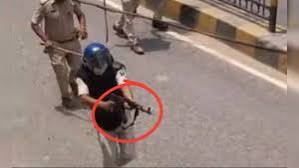
The Bihar Police has suspended Siwan constable Abhishek Kumar after he discharged four rounds into the air from an AK-47 assault rifle during a intense protest on Saturday, July 25. The incident occurred during a state-wide bandh in Siwan. At that time, a crowd surrounded and hurled stones at senior police officials. These included Siwan Superintendent of Police Puran Kumar Jha.
Fearing for the official’s safety, the constable fired warning shots into the air to disperse the mob. However, senior police headquarters officials confirmed that discharging an automatic weapon without direct authorisation from an on-duty.
Magistrate or senior commander constitutes a severe breach of standard operating procedures. Therefore, this prompted an immediate suspension and a formal departmental inquiry.
Strict Protocols and Restrictions Governing AK-47 Deployment
Under the Bihar Police Manual and overarching guidelines from the Ministry of Home Affairs, the deployment of automatic assault rifles like AK-47s, INSAS, and SLRs is heavily restricted.
Classified as “Platoon and Section Arms,” these high-powered weapons are intended for formation units and specialized operational groups. They are not for general law-and-order duties.
Regulations restrict their use to specialized forces such as the Anti-Naxal Task Force, Special Operation Groups, Counter-Terrorism units, and high-threat insurgency zones.
Furthermore, state circulars based on central directives explicitly ban routine bodyguards assigned to politicians, judges, and senior IAS or IPS officers from carrying automatic assault rifles. Instead, these orders mandate that personal security details use short-range firearms such as revolvers, pistols, and carbines.
Mandatory Step-by-Step Escalation Rules for Crowd Control
Statutory police manuals and procedural frameworks under the Bharatiya Nagarik Suraksha Sanhita dictate a strict, step-by-step escalation protocol. This applies when law enforcement deals with civilian demonstrations.
Officers must first attempt peaceful negotiation and verbal warnings. After that, they can use physical barricading, water cannons, tear gas, and lathi charges before considering non-lethal riot rounds such as rubber bullets.
The use of live ammunition and firearms is legally defined as an absolute last resort. It is permissible only to prevent imminent loss of life, counter lethal threats in self-defense, or stop the looting of police armories.
Because Constable Abhishek Kumar bypassed these mandatory escalation steps and fired an automatic assault rifle without an explicit command from a superior officer on the scene, the discharge violated established public order protocols. This is true regardless of the chaotic circumstances.
Constitutional Framework and Legal Standards for Lethal Force
Because “Public Order” and “Police” are designated as state subjects under the Seventh Schedule of the Constitution of India, individual State Police Manuals govern daily weapon authorization. There is no single central statute for this.
Neither the Bharatiya Nyaya Sanhita nor the Bharatiya Nagarik Suraksha Sanhita explicitly references specific firearm brands like the AK-47. However, automatic assault rifles are uniformly classified across the nation as Prohibited Bore weapons.
From a legal standpoint, whether an officer discharges a standard 9mm service pistol or a high-rate-of-fire AK-47, the legal threshold required to justify lethal force against civilians remains identical across all Indian states and union territories. Therefore, this standard is always the same.

Curated news reports, in-depth analysis, and special features by India’s Opinion editorial team.