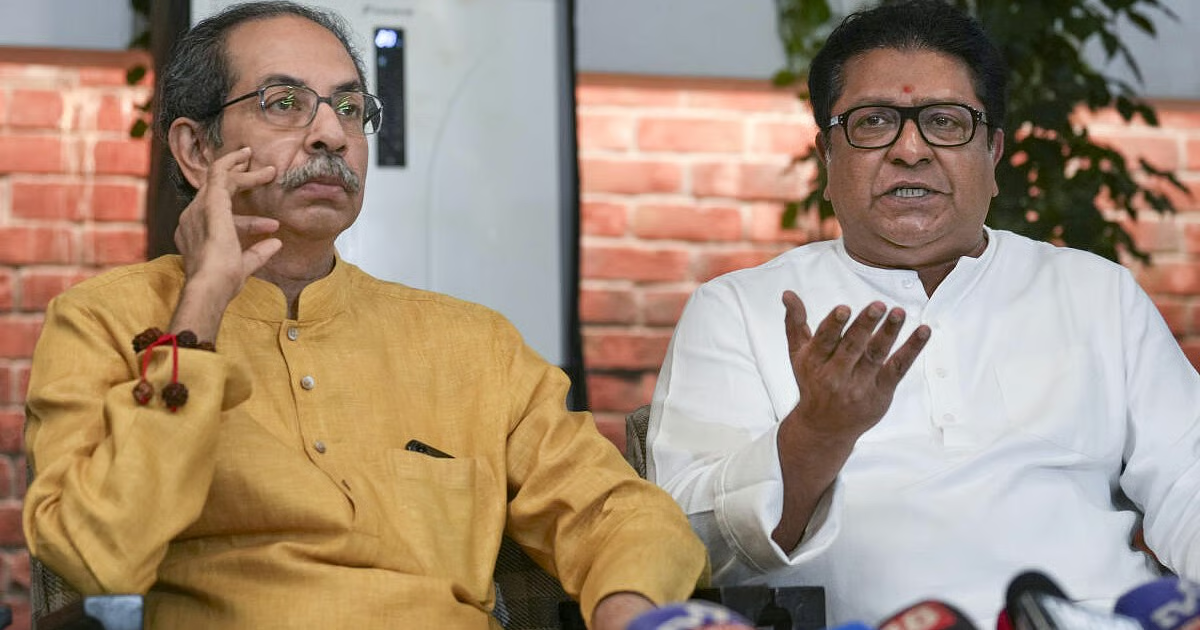
In a historic display of political realignment, estranged cousins Uddhav Thackeray and Raj Thackeray joined hands on Sunday to lead a massive protest march through the streets of Mumbai. The demonstration brought thousands of citizens together to challenge the Election Commission of India (ECI) and Chief Election Commissioner (CEC) Gyanesh Kumar.
However, the most striking visual of the Byculla-to-CSMT procession was the total absence of partisan symbols. Protesters carried neither the Shiv Sena (UBT)’s flaming torch nor the Maharashtra Navnirman Sena’s (MNS) railway engine flags.
Instead, demonstrators marched exclusively under the national Tricolour, according to an analytical report by The Indian Express.
Transforming a Political Dispute into a Citizens’ Cause
The deliberate decision to ban party flags aims to reframe the agitation as a constitutional defense of voting rights. The protest targets the controversial Special Intensive Revision (SIR) of electoral rolls, which opposition parties claim resulted in arbitrary voter deletions.
By shedding partisan banners, the organizers removed the stigma of routine political rivalry. Organizers wanted ordinary teachers, trade union workers, and non-aligned citizens to participate without feeling bound to any political party.
Consequently, the march transformed from an opposition campaign into a broader civil rights movement defending democratic franchise, as detailed by The Indian Express.
Bridging Decades of Ideological Friction
Ditching party symbols also solved a delicate operational challenge between the Thackeray cousins. Uddhav Thackeray leads a center-left coalition with the Congress and NCP (SP), while Raj Thackeray has historically championed aggressive regional and ideological rhetoric.
Marching under individual party banners would have caused ideological awkwardness for grassroots cadres walking side by side. Furthermore, it could have triggered unnecessary disputes among coalition allies over visual dominance.
The national flag provided an unassailable common denominator. Therefore, both leaders could stand together as defenders of the Constitution without compromising their respective party identities, according to reporting by Mid-Day.
Blunting Counter-Attacks from the Ruling Alliance
Adopting the Tricolour served an essential strategic purpose against political counter-offensives. The ruling Mahayuti government and the BJP routinely dismiss street protests as self-serving ploys by defeated politicians.
However, marching strictly with the national flag neutralizes that narrative. The imagery of thousands of Mumbaikars waving the national flag while singing patriotic anthems projects solemn constitutional duty.
In addition, it highlights that the fight against voter list manipulation touches every Indian, regardless of which ballot symbol they support in local elections.
A Powerful Message Ahead of State Battles
The massive turnout along south Mumbai’s commercial corridors proves that voting integrity concerns resonate deeply with urban voters.
By presenting a united family and civic front, the Thackeray cousins sent a firm warning to the poll panel ahead of upcoming electoral contests. Furthermore, the success of the flagless model offers a working blueprint for multi-party protests across the country.
Ultimately, walking beneath the national flag allowed Mumbai’s most famous political family to elevate a contentious bureaucratic fight into an inspiring battle to protect Indian democracy.

Curated news reports, in-depth analysis, and special features by India’s Opinion editorial team.