
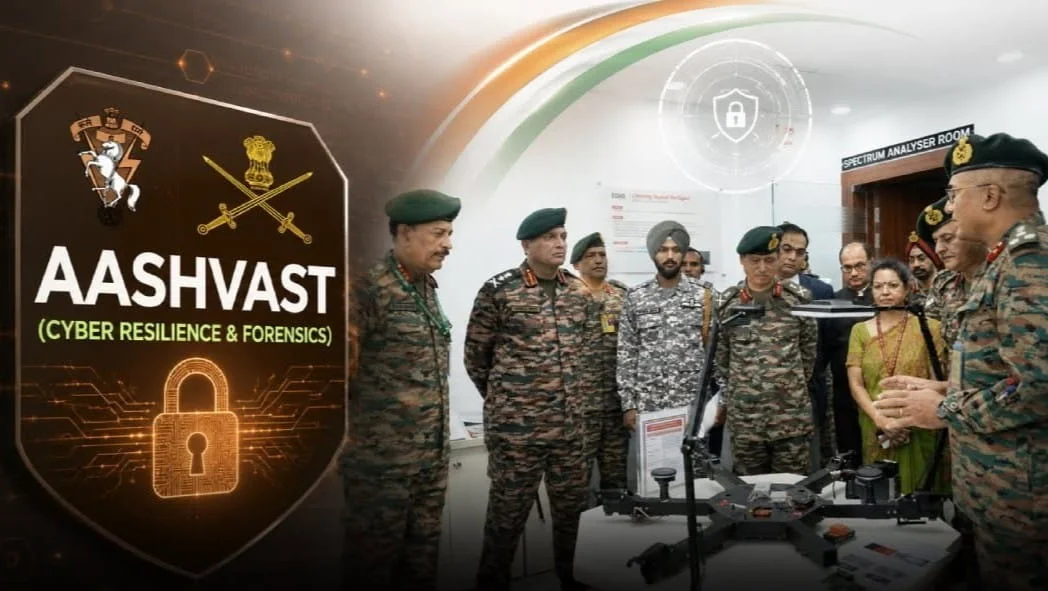
The Indian Army is establishing six specialized high-tech laboratories to eliminate foreign vulnerabilities from military electronics. These state-of-the-art facilities will conduct mandatory firmware inspections on all newly procured surveillance drones and cameras. Furthermore, the specialized security hubs operate under the project name AASHVAST across strategic regional military commands. One flagship testing facility is already functioning in New Delhi, reports Civilsdaily.
The acronym AASHVAST denotes Assessment and Analysis of Electronic Systems Hardware for Vulnerabilities and Security Threats. The Directorate General of Electronics and Mechanical Engineering developed the proprietary software validation suite with private industry partners. However, military procurement teams historically verified equipment origins relying strictly on commercial vendor invoices. Consequently, concealed foreign microchips and malicious firmware routines evaded routine pre-induction physical inspections.
Comprehensive Screening for Malicious Firmware Bugs
The specialized diagnostic suite can detect approximately fourteen distinct classes of critical software and hardware vulnerabilities. Technicians rigorously evaluate flight-control microcode rather than inspecting physical airframes alone during diagnostic screening runs. In addition, diagnostic tools identify hardcoded passwords, hidden backdoor tools, and dormant commands planted during manufacturing. These hidden cyber threats could allow adversarial operators to hijack unmanned systems remotely, notes The Indian Express.
Diagnostic tests also uncover location-specific traps and geospatial anomalies embedded within navigational guidance systems. Hostile programmers can design rogue microcode to disable drones whenever aircraft approach designated frontier sectors. Therefore, thorough silicon-level auditing prevents catastrophic mission failures along sensitive international borders. Similarly, military engineers subject every newly delivered drone batch to these rigorous operational simulations.
Countering Chinese Supply Chain Subversion
Security agencies remain acutely concerned about unauthorized Chinese subcomponents disguised inside commercial procurement channels. Unscrupulous suppliers frequently rebadge foreign sub-tier electronic parts as indigenous products to exploit relaxed procurement documentation. Moreover, emergency fast-track procurement windows compressed the time available for detailed technical evaluations in recent years. Defense planners emphasize that hardware invoices never guarantee what sits inside complex microelectronic circuits.
The Army Design Bureau submitted a comprehensive roadmap to eliminate hostile foreign parts from aerial inventories. Consequently, the defense ministry banned domestic manufacturers from incorporating sensitive components manufactured in neighboring adversarial countries. In addition, armed forces will soon extend these rigorous firmware validation protocols to fixed CCTV cameras. Networked surveillance cameras often utilize proprietary communication protocols capable of covertly exfiltrating military base data.
Operational Deployment and Strategic Impact
Five additional AASHVAST facilities will become operational across key logistical depots over upcoming months. These distributed centers will accelerate equipment certification while eliminating testing bottlenecks for frontline operational formations. Furthermore, the Directorate General of Electronics and Mechanical Engineering will maintain strict chain-of-custody protocols for tested systems. The technical corps ensures frontline infantry units receive thoroughly vetted combat hardware, observes SuperKalam.
Military cyber specialists will also examine post-induction software updates pushed by commercial equipment contractors. Commercial vendors routinely update flight firmware, creating potential attack windows for hostile supply chain interference. Nevertheless, army protocols will mandate cryptographic signing keys to prevent unauthorized post-induction system modifications. This rigorous approach seals dangerous operational gaps between initial factory delivery and everyday field deployment.
Fostering Domestic Defense Electronics Ecosystem
The mandatory inspection mandate directly reinforces the government’s ambitious Atmanirbhar Bharat self-reliance defense framework. Defense planners are actively incentivizing local semiconductor designers to manufacture trusted Indian flight controllers and sensors. Meanwhile, state laboratories are sharing vulnerability taxonomies with certified domestic aerospace startups to elevate engineering standards. Consequently, indigenous drone manufacturers must now incorporate verified secure code architectures into every design phase.
The deployment of six high-tech testing laboratories establishes an unprecedented benchmark for military cyber resilience. Armed forces worldwide increasingly confront sophisticated hybrid warfare tactics targeting electronic communication backbones. Furthermore, India’s proactive diagnostic shield safeguards critical intelligence assets during contested tactical operations. The AASHVAST initiative ensures that Indian soldiers operate modern battlefield equipment with absolute operational confidence.

Curated news reports, in-depth analysis, and special features by India’s Opinion editorial team.