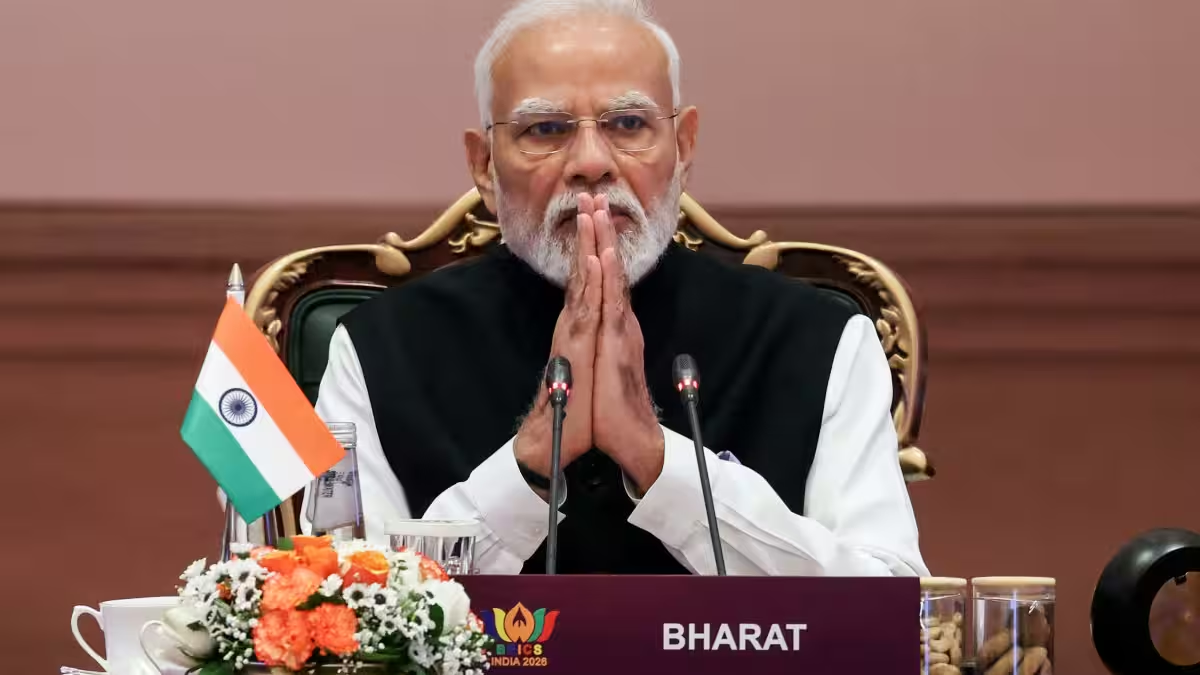
Prime Minister Narendra Modi emphasized the surging global relevance of the BRICS alliance on Sunday.
He addressed the 18th BRICS Summit in New Delhi during the flagship leaders’ plenary session.
He affirmed that the trust of Global South nations in BRICS has grown significantly.
India advanced the spirit of friendship, partnership, and shared development through the multilateral platform, as reported by ANI News.
Expanding Beyond Government Corridors to Empower Citizens
The Prime Minister underscored the importance of democratizing international cooperation.
He stressed that BRICS partnerships must not remain confined to diplomatic boardrooms.
Instead, he urged member states to connect ordinary citizens directly to multilateral initiatives.
Modi highlighted that farmers, researchers, young innovators, women entrepreneurs, and small business owners must drive collaborative growth.
Consequently, India’s chairship prioritized people-to-people initiatives alongside conventional state-level talks.
Furthermore, inclusive public participation builds deeper cultural affinity across continents.
Concrete Initiatives for Disaster Relief and Economic Growth
The New Delhi summit introduced several practical frameworks to address pressing global developmental challenges.
Modi detailed targeted joint programs focusing on disaster management, climate resilience, and supply chain security.
Member nations finalized cooperative agreements to support micro, small, and medium enterprises (MSMEs).
These initiatives will help emerging markets withstand global economic volatility and inflation shocks.
In addition, member states launched four agricultural programs to improve food productivity, as highlighted by The Indian Express.
Therefore, developing economies will gain access to climate-smart farming techniques and drought-resistant seed banks.
Economic Weight of the Expanded 11-Nation Bloc
The summit highlighted the vast demographic and commercial scale of the enlarged alliance.
The expanded grouping now accounts for half of the world’s total human population.
Economically, member economies generate over 40 percent of total global output.
They also command more than a quarter of all international commercial transactions.
Consequently, the alliance represents an indispensable pillar of contemporary global stability.
Modi noted that this immense economic weight creates a historic obligation to deliver tangible outcomes.
Championing Inclusivity and Multilateral Institutional Reform
The Prime Minister reiterated his call for comprehensive structural reforms in legacy global institutions.
He argued that bodies like the United Nations Security Council still mirror an outdated post-war architecture.
Therefore, global financial agencies like the IMF and the World Bank require modernization.
The leaders adopted the comprehensive BRICS New Delhi Declaration during the formal concluding ceremony.
The declaration commits member nations to equitable sovereign representation across international governance bodies, according to the Prime Minister’s Office (PMINDIA).
Furthermore, the document opposes unilateral trade measures like arbitrary carbon border taxes.
Diplomatic Outreach and High-Level Engagements
The final day featured intensive bilateral meetings between Prime Minister Modi and diverse Global South delegations.
He held structured discussions with visiting African leaders, including the Vice Presidents of Nigeria and Uganda.
These dialogues explored infrastructure partnerships, digital public goods, and healthcare technology transfers.
Meanwhile, India’s diplomatic leadership earned broad praise for forging consensus among competing geopolitical powers.
The summit concluded with a united pledge to build a resilient, multipolar world order.

Curated news reports, in-depth analysis, and special features by India’s Opinion editorial team.