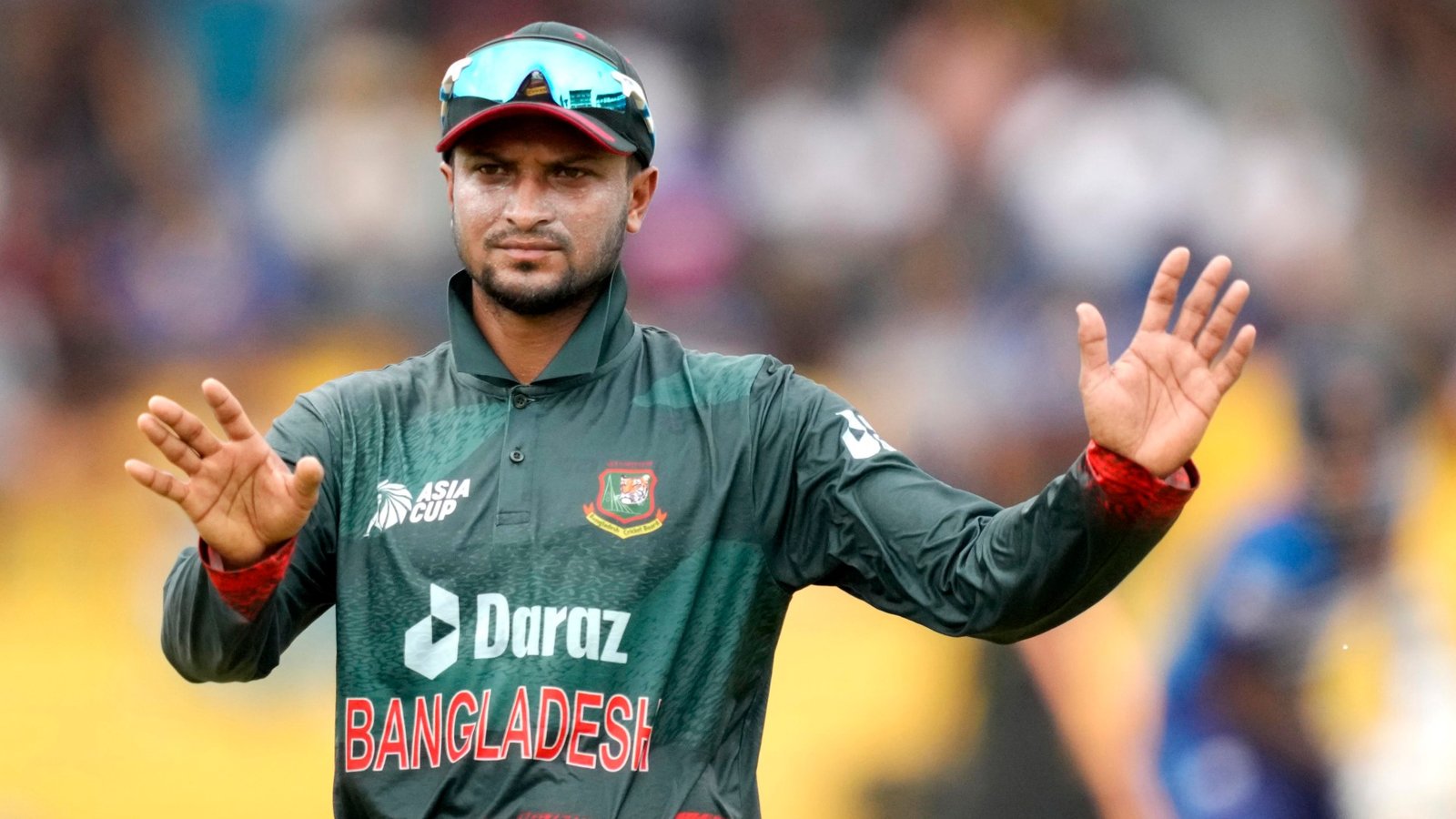
Shakib Al Hasan has opened the door to a return to Bangladesh, saying he is prepared to come home and face legal proceedings if authorities can guarantee his safety. For one of Bangladesh cricket’s most decorated players, the proposed comeback is now tied to a much bigger political and legal question.
The 39-year-old former Bangladesh captain has been living in the United States since the fall of Sheikh Hasina’s government in 2024. Shakib, who was also an Awami League lawmaker, faces investigations and charges that include murder, embezzlement, fraud and money laundering. He has described the allegations as fabricated. Shakib says he has not retired from international cricket.
He wants to return home for a farewell series and still hopes to represent Bangladesh at the 2027 ODI World Cup.
Shakib Al Hasan return depends on security
The central condition for Shakib’s return is security. He told Reuters that he is ready to return and face trial, but wants assurances that he will be safe.
His position comes after an earlier attempt to return to Bangladesh failed when assurances about his safety were withdrawn.
That history explains why Shakib is unwilling to simply board a flight home. His situation is no longer only about cricket. His political association with the former ruling party has made his return unusually sensitive.
The former all-rounder has also maintained that he will not distance himself from Sheikh Hasina or the Awami League.
Why Shakib’s political ties matter
Shakib’s political career became intertwined with his cricket career when he entered parliament as an Awami League candidate in January 2024. Months later, student-led protests brought down Hasina’s government.
Shakib remained outside Bangladesh as the political situation changed and legal cases emerged against figures associated with the former government.
His political affiliation has complicated what would normally be a straightforward farewell for one of Bangladesh’s greatest cricketers.
The issue became even more sensitive this week after Shakib appeared at a media event in New Delhi involving Hasina. His home in Bangladesh was subsequently attacked by unidentified people, according to Reuters.
The incident underlines the security concerns surrounding any possible return.
A cricket career that is not finished yet
Despite the uncertainty, Shakib still sees a sporting future. He wants to play a farewell series in Bangladesh and has set his sights on the 2027 ODI World Cup.
That would require him to return to international cricket at an age when most players have already moved into retirement. Shakib’s record gives context to his ambition.
He has been one of Bangladesh’s most important players across formats for more than a decade, combining left-arm spin with middle-order batting.
He has also captained Bangladesh and remained one of the country’s most recognisable sporting figures.
The question now is whether his cricketing ambitions can survive the political circumstances surrounding him.
The 2027 World Cup target
Shakib’s World Cup ambition gives the story a sporting deadline. The 2027 ODI World Cup will be played in South Africa, Zimbabwe and Namibia.
For Shakib to reach the tournament, he would first need to establish his availability. In addition, he would need to resolve the immediate obstacles to returning home. He must also convince selectors that he remains capable of contributing at international level.
Age would also become a factor.A return after a lengthy absence would require careful management.
Bangladesh would need to assess his fitness, match practice and ability to perform against international opposition.
The 2027 tournament could therefore become either the final chapter of his career or an ambition that remains unrealised.
More than a farewell match
For Shakib, a home farewell would carry an emotional significance that goes beyond cricket.
He has spent much of his career representing Bangladesh in major international tournaments and has built a reputation as one of the country’s leading all-rounders.
Yet returning home now would mean confronting legal proceedings and a changed political environment. His case also reflects the difficulties faced by public figures who become involved in politics.
Once Shakib entered parliament, his public identity expanded beyond sport. That association now affects his ability to return to the country he represented for years.
For now, Shakib has made his position clear. He says he is ready to return, face the legal process and seek one final opportunity to play for Bangladesh. Whether that farewell comes on a cricket field, and whether it can lead to the 2027 World Cup, will depend as much on events outside cricket as on Shakib’s performances inside it.

Curated news reports, in-depth analysis, and special features by India’s Opinion editorial team.