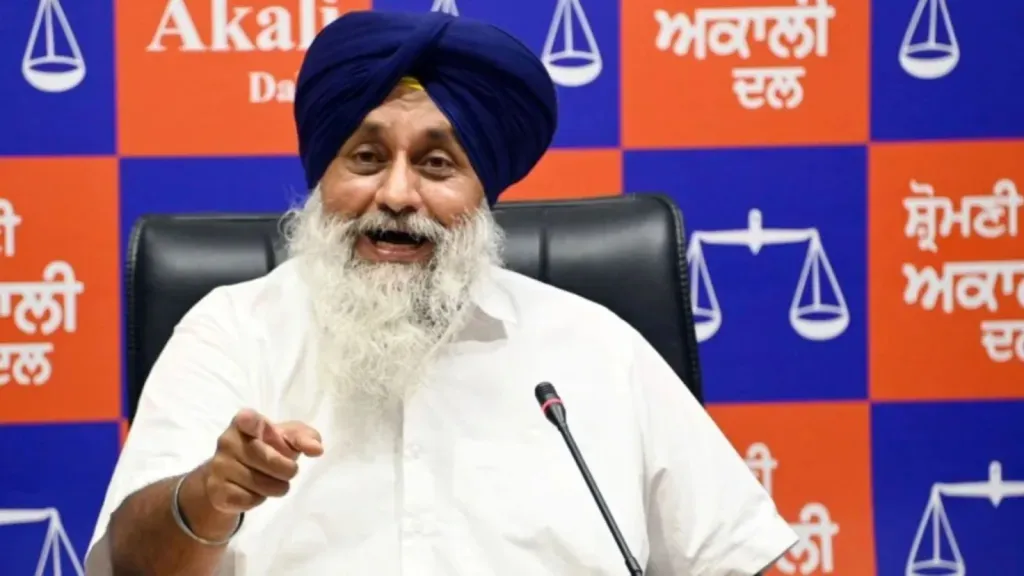
Shiromani Akali Dal (SAD) president Sukhbir Singh Badal met Prime Minister Narendra Modi at Parliament House in New Delhi on Friday afternoon. The brief 10-minute meeting triggered immediate political ripples across Punjab. The interaction comes at a time when both parties were reportedly preparing to contest the upcoming 2027 Punjab Assembly elections independently.
Neither the Prime Minister’s Office nor the Akali Dal issued an official post-meeting press statement. However, party sources confirmed that Badal raised key issues concerning Punjab during the discussion. The dialogue focused on the deteriorating law and order situation and alleged governance lapses under Chief Minister Bhagwant Mann’s Aam Aadmi Party (AAP) government.
What Transpired During the High-Level Meeting in Parliament?
Sukhbir Singh Badal arrived at Parliament House around noon to meet the Prime Minister. According to senior SAD leaders, Badal briefed PM Modi on pressing regional challenges affecting the border state.
He highlighted growing public dissatisfaction with state welfare delivery, economic pressures, and rising crime across urban and rural belts.
In addition, Badal pointed out alleged financial irregularities within various state government schemes run by the ruling AAP administration. While the official briefing focused strictly on state administrative concerns, political analysts view the meeting as a significant icebreaker between the two long-standing former allies.
Why Is the Timing of the Modi-Badal Meeting Significant?
The meeting assumes immense strategic importance as all major political parties gear up for the 2027 Punjab Legislative Assembly elections. Over recent months, state leadership from both the BJP and SAD had publicly maintained that they were ready to go solo.
The BJP had been aggressively expanding its organizational footprint across all 117 assembly constituencies, relying heavily on leaders who recently joined from rival parties.
However, the political math in Punjab remains complex. Opposition parties face a formidable opponent in AAP, which won a historic mandate in 2022.
The sudden top-level meeting in Delhi has forced political strategists to re-evaluate whether the BJP and SAD might reconsider a formal seat-sharing agreement to build a unified opposition front.
A Decade of Alliance, Split Over Farm Laws, and Electoral Reconstitution
The SAD and the BJP shared a long-standing alliance under the National Democratic Alliance (NDA) banner for over two decades. That partnership broke down in September 2020 over the central government’s controversial farm laws, leading SAD to exit the NDA and resign from the Union Cabinet.
Even after the Centre repealed the farm legislations in late 2021, political relations between the two parties remained cold and distant.
The separation severely impacted both parties in the 2022 state elections. Contesting independently, the SAD won just 3 seats while the BJP secured 2 seats in the 117-member assembly, allowing AAP to sweep to power with 92 seats.
Today’s meeting signals that both sides may be open to pragmatic political dialogue as they recalculate their chances for 2027.

Curated news reports, in-depth analysis, and special features by India’s Opinion editorial team.