The BJP-led NDA is facing a test that goes beyond an ordinary parliamentary majority. Its push to secure a two-thirds strength in Parliament has become central to its plans for constitutional changes. These changes are linked to delimitation, Lok Sabha expansion and women’s reservation.
The political effort, described within BJP circles as Mission 360 delimitation, gained momentum after the government failed to get the required numbers for its constitutional amendment proposal during the April special sitting. The government has since explored support from regional parties and smaller political formations. The arithmetic matters because a constitutional amendment normally requires a special majority.
Each House must pass the amendment by a majority of its total membership and by at least two-thirds of members present and voting. That makes the exercise very different from passing an ordinary Bill.
Why Mission 360 delimitation needs 360 votes
The phrase Mission 360 delimitation refers to the BJP’s reported effort to build a two-thirds bloc in Parliament. The exact number required can vary with attendance and the strength of the House. So 360 is better understood as a political target rather than a permanently fixed constitutional threshold.
The strategy became more urgent after the Constitution (131st Amendment) Bill, 2026, failed to clear the Lok Sabha in April. The government had linked the proposal to changes that would enable an earlier implementation of women’s reservation. It would also prepare the framework for a fresh delimitation exercise.
Reports in July indicated that the NDA remained short of the two-thirds mark and was looking towards parties outside its formal alliance. The BJP’s outreach has included discussions involving the DMK and NCP (Sharad Pawar), among others.
That outreach highlights the political calculation behind the Mission 360 delimitation campaign. The government does not simply need allies who support it on routine legislation. It needs enough MPs to cross a much higher constitutional threshold.
What the delimitation proposal would change
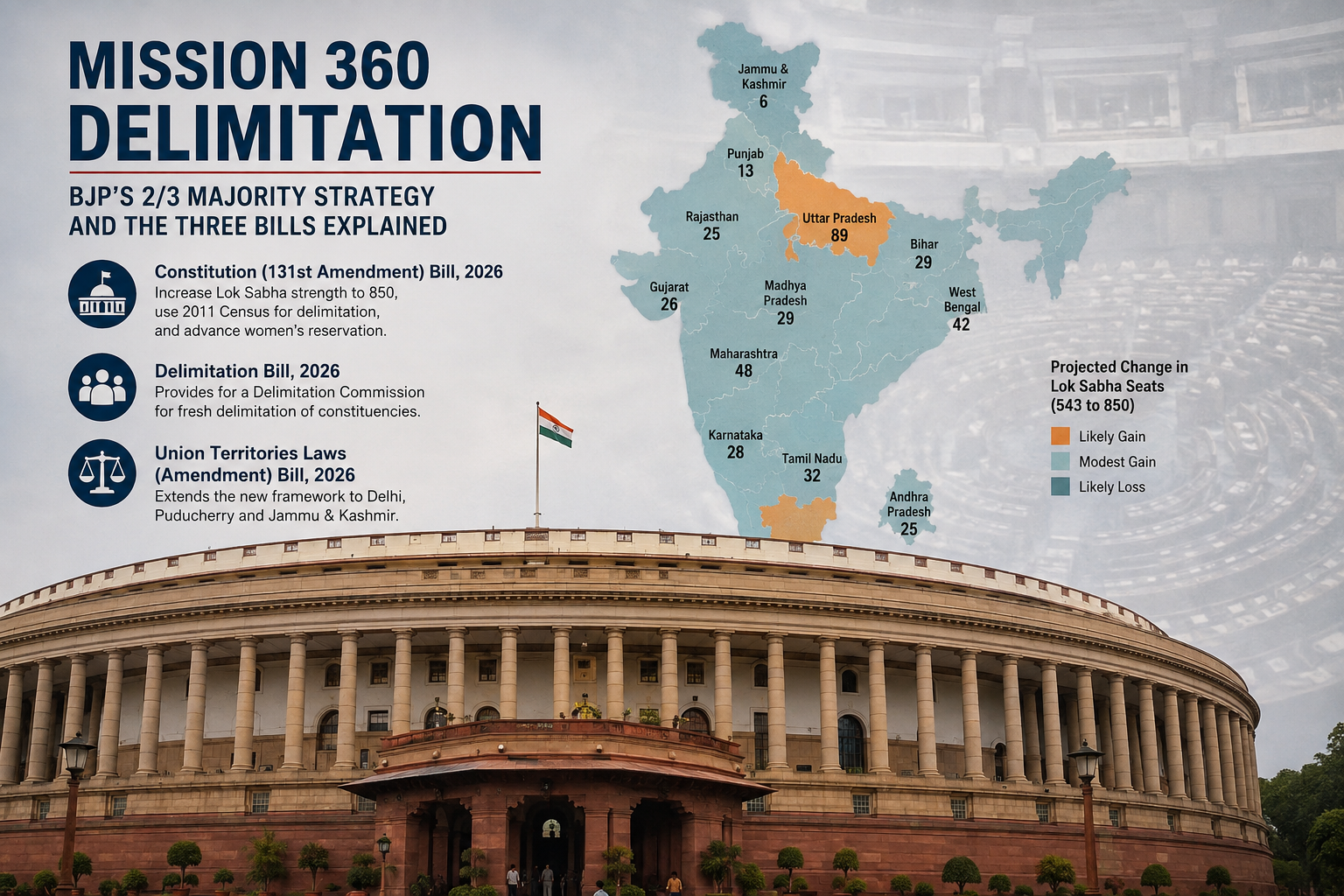
The proposed reforms could alter the size and balance of the Lok Sabha. The Constitution (131st Amendment) Bill sought to raise the maximum strength of the House from 550 to 850.
The accompanying proposals would allow the next delimitation to use the 2011 Census rather than waiting for the 2027 Census.
The proposal also seeks to remove the existing link between the implementation of women’s reservation and completion of a post-2023 Census delimitation process.
That connection matters for the 2029 election. Under the existing framework created by the 106th Constitutional Amendment in 2023, one-third reservation for women in the Lok Sabha and state assemblies depends on a census followed by delimitation.
The government has therefore explored legislative changes that could bring the reservation into effect earlier.
The Mission 360 delimitation strategy therefore combines two politically powerful issues: representation by population and women’s representation in legislatures.
Why southern states are worried
The core dispute is not simply about increasing the number of MPs. It concerns how those seats would be distributed among states.
India froze the allocation of Lok Sabha seats among states using the 1971 Census after concerns that states should not lose representation because they had successfully pursued population stabilisation.
The freeze was extended by the 84th Constitutional Amendment until the first Census after 2026.
A delimitation based on population could therefore change the balance between states that have experienced faster population growth and those that have recorded slower growth.
PRS Legislative Research’s projections illustrate the political sensitivity. If the current 543-seat strength were retained, its analysis projects Uttar Pradesh rising from 80 to 89 seats. Meanwhile, Tamil Nadu could fall from 39 to 32 and Kerala from 20 to 15.
If the House expands by about 50 percent, several southern states would gain seats in absolute terms, but their share of the House could still change. These projections are not the government’s final allocation.
The eventual figures would depend on the law, the delimitation exercise and the rules adopted by the authorities. Still, they explain why southern parties have demanded safeguards.
The BJP’s political arithmetic
The Mission 360 delimitation push also reflects a wider parliamentary reality. The BJP lost its single-party majority in the 2024 Lok Sabha election and formed the government with NDA partners. That change made constitutional legislation harder to pass.
The government can still pass ordinary legislation when it has the necessary numbers, but constitutional amendments require a much stronger coalition. The BJP has therefore focused on expanding its support base rather than relying only on its established allies.
Recent political developments, including splits within opposition parties, have altered the arithmetic and encouraged the ruling alliance to reassess its options.
The strategy is not without risk. Bringing regional parties on board could require assurances over state representation.
The DMK, for example, has indicated that its position depends heavily on protecting Tamil Nadu’s interests. NCP (SP) leader Supriya Sule has also linked possible support to a guarantee that seats and representation would increase across states.
Why women’s reservation is tied to the debate
The Mission 360 delimitation strategy gains another political dimension because the government has connected delimitation with women’s reservation. The 2023 constitutional amendment reserved one-third of seats for women in the Lok Sabha and state assemblies.
However, the reservation does not operate immediately. It becomes effective after the relevant Census and delimitation process.The proposed constitutional changes seek to remove that delay.
A larger Lok Sabha would also create additional constituencies, potentially allowing the government to implement the quota without reducing the number of existing seats available to male MPs.
This approach could make the proposal easier to defend politically. Supporters can frame it as an expansion of representation rather than simply a redistribution of existing constituencies.
The federal question behind the numbers
The most difficult issue for Mission 360 delimitation may be federal rather than partisan.
Population-based representation follows a straightforward democratic principle: constituencies should broadly represent comparable numbers of citizens. Yet India’s earlier decision to freeze state-wise representation recognised another principle.
States that controlled population growth should not automatically lose political weight. That tension has remained unresolved for decades.
Delimitation now brings it back to the centre of national politics.The proposed increase in Lok Sabha strength also raises institutional questions.
PRS has pointed out that the proposed maximum of 850 Lok Sabha members would change the balance between the two Houses because the Constitution’s maximum Rajya Sabha strength would remain 250. It could also affect joint sittings and the relative weight of the two Houses in parliamentary decision-making.
What happens next
The Mission 360 delimitation campaign will ultimately depend on whether the BJP can convert political negotiations into votes. Support from individual regional parties could prove decisive, particularly if those parties secure assurances over the distribution of seats. The debate will also intensify in southern states, where political parties fear that population-based delimitation could reduce their relative influence in national politics.
Congress leader Rahul Gandhi has already urged parties in Tamil Nadu to oppose the proposed changes, while the DMK has publicly pushed back against suggestions that it has agreed to support the government’s plan. For the BJP, Mission 360 delimitation is therefore more than a parliamentary numbers game. It is an attempt to build the constitutional majority needed for reforms that could reshape India’s electoral map.
The central question now is whether the government can find a formula that satisfies the demand for representation based on population without convincing southern states that they are being penalised for demographic policies followed over decades. Until that balance is found, the two-thirds target will remain as much a political negotiation as a question of parliamentary arithmetic.

Curated news reports, in-depth analysis, and special features by India’s Opinion editorial team.