
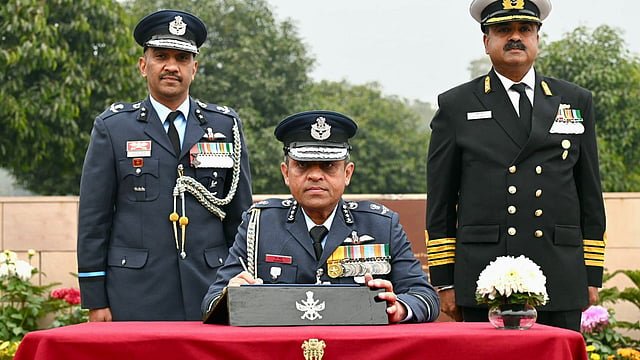
IAF Stresses Collaboration, Indigenous Innovation to Strengthen India’s Aerospace Capability
India’s push for self-reliance in defence received another boost on Wednesday as the Indian Air Force (IAF) underlined the need for stronger collaboration between the armed forces, industry, academia and startups to build future-ready aerospace systems. The message comes at a time when India is accelerating indigenous defence manufacturing. Moreover, the country is seeking to reduce dependence on imported military technology.
Senior IAF officials said that the country’s long-term security will depend not only on advanced fighter aircraft. They also emphasized sustained innovation across propulsion systems, avionics, artificial intelligence, unmanned platforms, sensors, advanced materials and maintenance technologies. In addition, the Air Force stressed that closer engagement with Indian companies and research institutions is essential. This engagement is critical to convert innovative ideas into operational capabilities.
Why IAF aerospace capability is a national priority
The emphasis on IAF aerospace capability reflects India’s broader goal of achieving defence self-reliance under the Atmanirbhar Bharat initiative. Over the past decade, the government has increased support for indigenous defence production. This comes through procurement reforms, higher domestic sourcing and partnerships with private industry.
India has also emerged as a growing defence exporter. According to official government data, defence exports have risen sharply in recent years. Indian-made military equipment now reaches more than 100 countries. Furthermore, the Air Force believes this expanding industrial ecosystem can also strengthen its operational preparedness.
Industry, startups and academia expected to play a bigger role
The IAF called for deeper cooperation between operational users and technology developers. Officials said innovation cannot remain confined to government laboratories. Additionally, universities, startups, micro, small and medium enterprises, and established defence manufacturers all have an important role in developing next-generation aerospace technologies.
Such collaboration allows the Air Force to communicate operational challenges directly to industry. It also enables manufacturers to design products that meet military requirements. As a result, this approach is expected to reduce development timelines and improve indigenous production capabilities.
Indigenous programmes gather momentum
India’s aerospace ecosystem has expanded rapidly with projects such as the LCA Tejas. It also grew through the Light Combat Helicopter Prachand, Advanced Medium Combat Aircraft (AMCA), Combat Air Teaming System (CATS), and upgrades for the Su-30MKI fleet involving greater indigenous content.
The Defence Research and Development Organisation (DRDO), Hindustan Aeronautics Limited (HAL), the Aeronautical Development Agency (ADA) and several private companies continue to work together on advanced aircraft, weapons, avionics and electronic warfare systems. These are designed for future combat environments.
Recent technological milestones strengthen confidence
The focus on IAF aerospace capability comes shortly after India successfully developed its first indigenous expendable turbojet engine in the 350 kg thrust class. This engine was developed by DRDO’s Gas Turbine Research Establishment in collaboration with Hyderabad-based Azad Engineering. Importantly, the engine is expected to power future missile systems and reduce dependence on foreign propulsion technologies.
Defence experts believe indigenous propulsion technology is among the most critical areas for India’s long-term aerospace ambitions. This is because engine technology has traditionally been one of the country’s biggest strategic challenges.
Preparing for future warfare
Modern air combat increasingly relies on network-centric operations rather than individual aircraft performance. Artificial intelligence, autonomous drones, electronic warfare, precision-guided weapons, cyber resilience and secure communications are becoming central to military planning.
The IAF said collaboration across government agencies, private industry and research institutions will help India remain prepared for these evolving challenges. At the same time, this will ensure that indigenous technologies keep pace with global developments.
Building a globally competitive aerospace ecosystem
Officials also highlighted the importance of developing a globally competitive aerospace manufacturing base capable of supporting both domestic requirements and exports. India’s growing defence industrial base has attracted increasing participation from private companies, startups and international partners. This is mainly through joint development and technology collaborations.
Industry outreach programmes organised by the Air Force aim to bridge the gap between operational requirements and industrial innovation. These programmes create opportunities for Indian companies to contribute directly to national security.
What comes next?
The renewed emphasis on IAF aerospace capability signals that India’s defence modernisation strategy will increasingly depend on collaboration rather than isolated development. As indigenous programmes mature and new technologies enter service, the success of India’s aerospace ambitions will depend on sustained cooperation between the military, scientists, industry and academia. That partnership is expected to shape the next generation of Indian air power. It will also strengthen the country’s position in the global aerospace sector.

Curated news reports, in-depth analysis, and special features by India’s Opinion editorial team.