
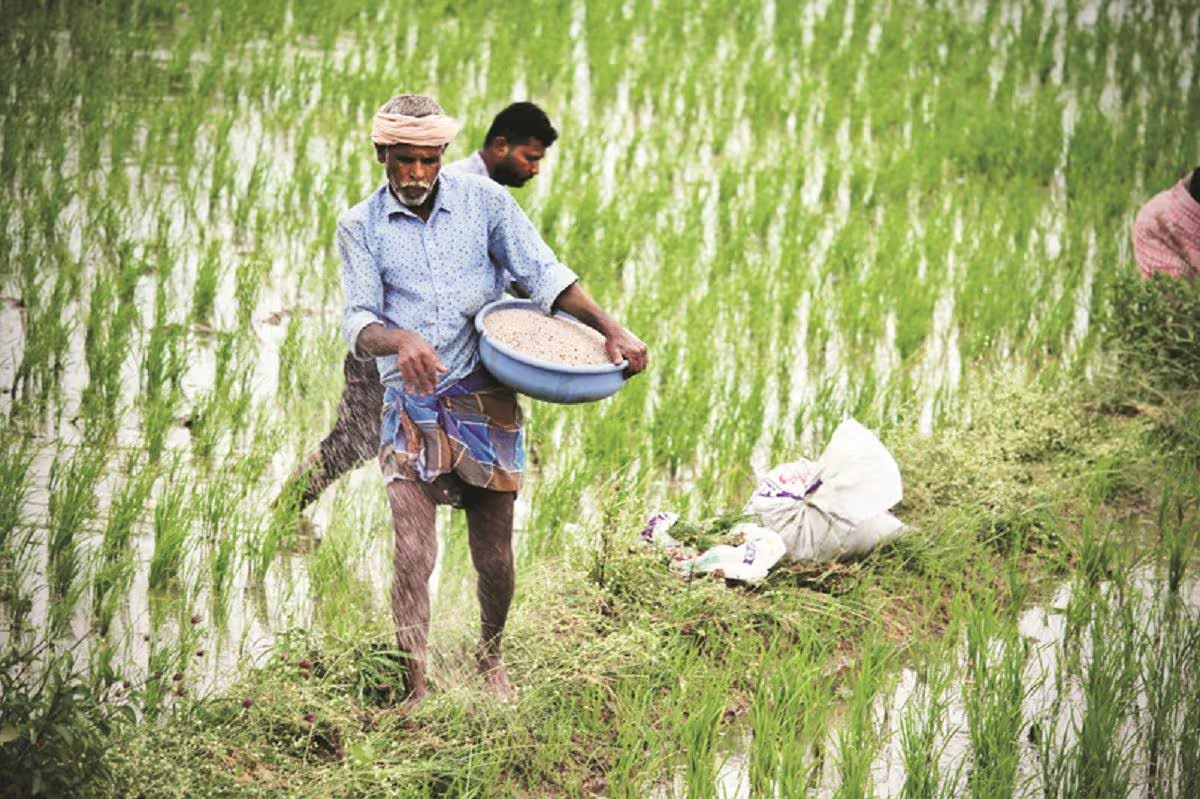
India’s farmers are staring at a fertiliser squeeze this season, and it has little to do with anything happening in their own fields. Renewed conflict around the Strait of Hormuz has choked off a large share of the Gulf shipments India depends on for urea, forcing many farms to work with less than they’re used to. But agronomists say that constraint might not be the disaster it first appears. A large share of the urea Indian farmers apply every season never actually reaches the crop at all, and using less of it, applied smarter, can leave yields untouched or even improve them.
Why the shortage is happening now
Roughly two-thirds of India’s urea imports have traditionally moved through the Strait of Hormuz. The strait briefly reopened to commercial traffic in April after an earlier ceasefire, offering some relief. That relief has proven short-lived. With US strikes on Iran and retaliatory attacks on Gulf shipping resuming in recent weeks, ammonia and urea production across the region has again been disrupted, and international nitrogen prices have climbed sharply.
India has leaned on emergency measures to get through similar squeezes before: buying urea and LNG on spot markets at prices well above pre-war levels, and signing long-term supply contracts with producers outside the Gulf, including a deal with Saudi Arabia that bypasses Hormuz entirely. But those workarounds come at a cost. The government’s fertiliser subsidy bill has already ballooned past its budgeted estimate, and officials have made clear they would rather see farmers use urea more efficiently than keep absorbing ever-larger import bills.
Where all that “extra” urea actually goes
When urea is added to moist soil, natural enzymes break it down into ammonia. If a plant cannot absorb the resulting nitrogen quickly enough, it is lost in one of two ways, and neither of them helps the crop.
The first is volatilization: urea converts into ammonia gas and evaporates straight into the air. Up to 30 percent or more of surface-applied urea can disappear this way before a plant ever gets to use it.
The second is leaching. Soil bacteria convert excess nitrogen into nitrates, which do not bind well to soil particles. Rain or heavy irrigation washes them deep underground into water tables, a major contributor to groundwater nitrate pollution in intensively farmed regions.
In other words, on a typical over-fertilised field, a meaningful chunk of every bag of urea was never going to help the harvest in the first place.
Why more urea can mean a worse harvest
Over-application does not just waste money, it can actively hurt the crop. Fields pushed with excess urea often show hyper-vegetative growth: tall, bushy, dark green plants that look thriving but are quietly storing up problems.
Plants in this state spend their energy building soft leaf tissue instead of strong structural cell walls, leaving weak stems prone to lodging, where a heavy wind or rainstorm flattens the crop outright. Soft, sap-rich leaves also draw aphids, caterpillars and fungal spores, pushing up pesticide costs. And energy spent growing tall leaves is energy taken directly away from producing grain, seed or fruit, the part of the plant that actually reaches market.
This is the paradox at the heart of the shortage a field that receives less urea, applied at the right time, can end up with sturdier stems, fewer pests and a bigger harvest than one that received more
Neem-coated urea: getting more out of every bag
One fix already being pushed by the government is neem-coated urea, now mandatory for all domestic production. Each granule carries a thin layer of natural neem oil that acts as a nitrification inhibitor, slowing the rate at which soil bacteria convert urea into nitrate.
Instead of dissolving almost instantly and flooding the soil with more nitrogen than a young plant can use, neem-coated urea releases nitrogen gradually over several weeks, timed closer to how a plant’s roots actually grow and absorb nutrients. Less nitrogen escapes as gas or leaches into groundwater, which means farmers get more usable nutrition out of every bag, exactly the efficiency gain a shortage year demands.
Splitting doses instead of dumping it all at once
The other lever farmers can pull is timing. Applying an entire season’s urea in one go is not unlike feeding a month’s worth of food to an infant in a single sitting, most of it goes to waste.
A split-dose approach spreads urea across three applications instead: a small basal dose at sowing to support root development, a second dose during tillering or branching when the plant enters rapid growth, and a third at flowering or grain formation to help the plant channel energy into bigger, heavier grains. Splitting one bag into three smaller doses has been shown to deliver better growth while using fewer total bags across a season.
What this means for the season ahead
A genuine urea shortage is still a real risk if Hormuz tensions drag on, and no amount of efficient application fully substitutes for adequate supply. But this season offers an unusual test case: whether neem-coated urea and split-dose scheduling, adopted out of necessity rather than choice, end up showing farmers something they can carry forward even after the shipping lanes reopen. The early signs from fields that have already switched suggest less fertiliser, used well, may turn out to be the better habit all along.

Ritika is an agricultural consultant and agronomy scholar with a postgraduate degree in agronomy. She writes on sustainable farming practices, drawing on years of hands-on experience advising farmers on crop nutrition and yield optimisation.