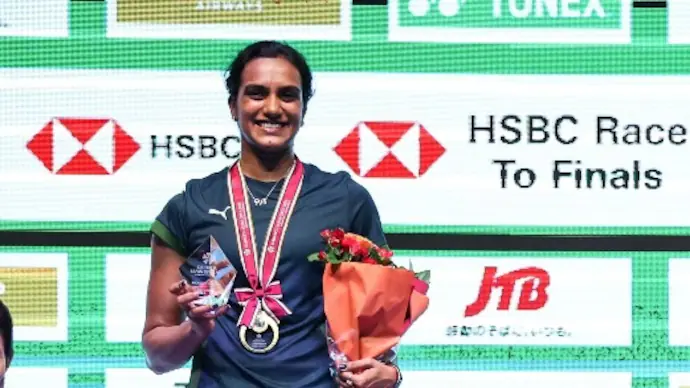
PV Sindhu turned back the clock in Tokyo on Sunday. She beat reigning world champion Akane Yamaguchi in straight games to win her first Japan Open title, and with it, ended a wait that had stretched across seven years and countless false starts.
The 31-year-old needed just 50 minutes to close out a 21-17, 21-17 victory at the Tokyo Metropolitan Gymnasium. It was the kind of attacking, front-foot badminton that once made her one of the most feared players on the tour, and one that had gone missing for long stretches in recent seasons.
A title seven years in the making
Sindhu’s last major title on the BWF World Tour came at the 2022 Commonwealth Games. A stress fracture in her left ankle soon after robbed her of match time and rhythm, and for several seasons she looked, by her own admission, like a shadow of the player who once dominated women’s singles badminton.
This year told a different story. Sindhu, who has made no secret of her ambitions for the Los Angeles Olympics, had been quietly rebuilding her season. A semi-final run at the Malaysia Open Super 1000, a quarter-final finish at the Indonesia Masters Super 500 in January. Another semi-final appearance at the Australian Open in June. The pieces were falling into place. Japan is where they finally clicked.
How the final unfolded
Sindhu arrived in Tokyo ranked 12th in the world, having reached her first-ever Super 750 final after semi-final opponent Chen Yufei retired hurt with a hamstring injury while trailing 21-19, 15-10. Yamaguchi, the world No. 3 and three-time world champion, had looked equally sharp en route to the final, beating Indonesia’s Putri Kusuma Wardani in the other semi-final.
None of that form carried over once Sindhu found her range. She controlled long rallies, dictated pace from the back of the court and denied Yamaguchi the extended exchanges that usually favour the Japanese player’s game.
The tensest moment came at 20-17 in the second game. A line judge called a Yamaguchi shot wide, appearing to hand Sindhu the title, only for Yamaguchi to immediately challenge the call. The review lasted roughly 30 seconds. When it went in Sindhu’s favour, she bowed and touched the court before throwing her arms wide and rushing to embrace her coach, Irwansyah Adi Pratama.
The coach behind the comeback
Irwansyah, the veteran Indonesian tactician, joined Sindhu’s camp in 2025. Since then, she has rediscovered the aggressive, attacking instincts that defined her best years, paired with a sharper focus on fitness that has kept her consistently reaching the quarter-finals and semi-finals of major events rather than exiting early.
Sunday’s win was Sindhu’s first World Tour title since the Syed Modi International in December 2024. And more significantly, her first at Super 750 level or above since she won the World Championships in Basel back in August 2019. The two numbers, five years apart, capture how long this particular breakthrough had been overdue.
Old rivals, familiar respect
Sindhu and Yamaguchi have now met 30 times on the international circuit, one of women’s singles badminton’s most enduring rivalries. Sindhu holds a narrow edge in their head-to-head record. After the medal ceremony, the two posed for a selfie together, a gesture that did not go unnoticed by commentators watching two of the sport’s longest-serving stars share a podium once again.
Sindhu was the only Indian shuttler left standing in the tournament by the final. Lakshya Sen and Ayush Shetty had both exited in the opening round, while the men’s doubles pair of Satwiksairaj Rankireddy and Chirag Shetty were forced to retire hurt during their first match.
What this means going forward
A Super 750 title at 31, built on renewed fitness and a coaching change that has clearly paid off, gives Sindhu genuine momentum heading into the back half of the Olympic qualification cycle. Whether Tokyo marks a turning point or a one-off return to form will depend on how she carries this level into the remaining Super 1000 and World Championship events before Los Angeles 2028, but for now, Indian badminton has its answer to a question that had lingered for seven long years.

Curated news reports, in-depth analysis, and special features by India’s Opinion editorial team.