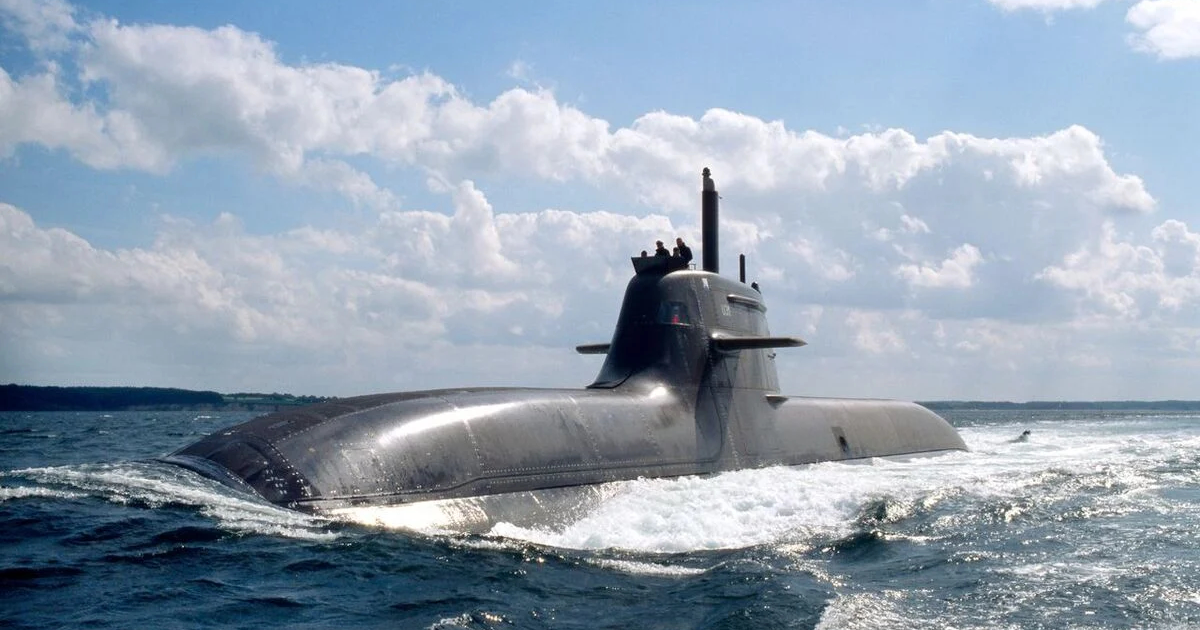
India is closing in on a massive ₹70,000-crore mega-defence deal. The agreement involves Germany to construct six next-generation stealth submarines for the Indian Navy. The landmark deal, under Project-75 India (P-75I), has cleared key administrative and financial stages. A final high-level review by the Cabinet is expected shortly to grant the ultimate sign-off. This project has generated global interest, and is considered one of the most significant India Germany submarine deals to date.
Strategic Breakthrough Under Project-75I
The multi-billion-dollar acquisition aims to bolster India’s underwater combat fleet amid expanding Chinese naval presence in the Indian Ocean Region.
State-run Mazagon Dock Shipbuilders Limited (MDL) in Mumbai will partner with German defense major ThyssenKrupp Marine Systems (tkMS) to build all six conventional diesel-electric vessels in India.
The joint effort edged out a rival proposal from Spain’s Navantia and Larsen & Toubro. The Ministry of Finance gave its clearance to the procurement roadmap, setting the stage for the formal contract execution.
Cutting-Edge Air-Independent Propulsion Technology
At the heart of the agreement is the integration of proven Air-Independent Propulsion (AIP) systems based on Germany’s HDW Class 214 design.
Standard diesel-electric submarines must surface or snorkel every few days to recharge their batteries, making them vulnerable to enemy radar.
The advanced fuel-cell AIP technology allows these vessels to remain submerged continuously for up to three weeks. This capability dramatically reduces acoustic signatures and vastly improves operational stealth.
Boosting Local Defense Manufacturing
Aligning with the government’s Make in India vision, the contract mandates significant technology transfer from Germany. The initial submarine will feature a minimum local content of 45 percent, which will scale up to 60 percent by the sixth vessel.
The contract structure guarantees full transfer of design and manufacturing know-how to Indian yards.
Delivery of the first submarine is scheduled seven years post-signing, with subsequent units joining the fleet at a rate of one per year.
Critical Upgrade For Naval Power
The Indian Navy currently operates an aging fleet of conventional submarines, including Russian-origin Kilo-class and German Type-209 vessels, many of which face decommissioning in the coming decade.
The induction of these six stealth submarines will bridge operational gaps and reinforce India’s maritime deterrence.
Combined with indigenous nuclear submarine developments, the P-75I fleet forms a cornerstone of India’s strategic roadmap to secure key sea lanes and maintain regional stability.
Technical Capabilities And Comparisons
The German HDW Class 214 submarine measures up to 71 meters long. It has a submerged displacement of around 1,860 tonnes. The hull uses high-yield HY-100 non-magnetic steel.
This design supports operational diving depths exceeding 400 meters. The vessel integrates eight 533 mm bow torpedo tubes. These tubes fire heavyweight torpedoes, anti-ship missiles, and mines.
Its standout feature is the Siemens fuel cell AIP system. It generates electricity directly using hydrogen and oxygen. The chemical reaction produces no internal combustion. The system releases only freshwater as a byproduct.
This process enables continuous, silent submerged operations for up to three weeks. It operates with extremely low acoustic and thermal signatures.
By comparison, the French Scorpène-class submarine displaces around 1,870 tonnes. It has six 533 mm torpedo tubes launching up to 18 weapons. However, the Class 214 holds a distinct edge in stealth and propulsion.
The French platform traditionally relied on combustion-based MESMA steam turbine AIP or retrofitted fuel cells. In contrast, the German vessel uses an natively integrated fuel cell AIP.
It eliminates moving parts and dramatically reduces acoustic noise. It also utilizes externally mounted metal hydride storage tanks for superior safety and lower detection probability.

Curated news reports, in-depth analysis, and special features by India’s Opinion editorial team.