
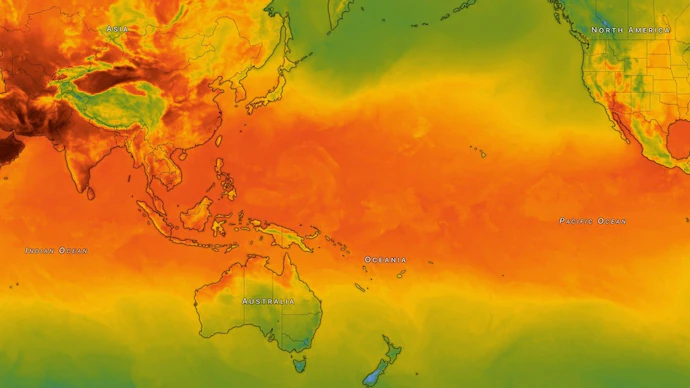
Global weather agencies have issued an urgent climate alert. Ocean waters across the central and eastern tropical Pacific Ocean are warming at a rate rarely seen in modern meteorology. According to the U.S. National Oceanic and Atmospheric Administration and the World Meteorological Organization, the developing El Niño could become one of the strongest on record since reliable tracking began in 1950. While the physical origin of this oceanic shift sits thousands of kilometers away, its economic and ecological shadow lands directly on the Indian subcontinent.
The Atmospheric Science Behind the Threat
El Niño is not a localized storm system. It is a large-scale disruption of the Walker Circulation, which acts as the primary atmospheric conveyor belt driving moisture-laden trade winds across the equator. Under normal circumstances, warm surface waters accumulate in the western Pacific near Indonesia, pulling rain clouds toward South and Southeast Asia.
When El Niño takes hold, ocean waters in the central Pacific heat up by two degrees Celsius or more above average. This thermal reversal causes atmospheric pressure systems to flip. Heavy rainfall shifts east toward South America, leaving the Indian monsoon starved of vital atmospheric force before it even reaches Indian shores.
Historical records demonstrate that nearly seventy percent of all El Niño occurrences since 1950 have disrupted Indian monsoon rainfall to varying degrees. However, the phenomenon does not manifest identically in every cycle. During the 2002 moderate El Niño, India suffered a severe national rainfall deficit of twenty-one percent.
Conversely, the much stronger 2015 episode resulted in a smaller thirteen percent deficit, proving that regional ocean dynamics can alter the outcome. The current 2026 monsoon season illustrates this complexity, having endured a thirty-five percent rainfall deficit in June before brief low-pressure systems over the Bay of Bengal brought temporary relief to central India in July.
Agriculture, Fodder, and the Rural Economy
For India, the most immediate channel of transmission is agriculture. More than half of the country’s net sown area depends entirely on seasonal rainfall without access to canals or groundwater pumps.
Rain-fed agriculture accounts for roughly forty percent of national food production. Standing crops like paddy, pulses, soybean, and cotton require steady rainfall through August and September during their critical grain-forming stages.
When rainfall fails or comes in violent, uneven bursts, soil erosion increases while root systems dry out, leading to substantial yield contractions across rain-dependent states like Maharashtra, Karnataka, Gujarat, and Bihar.
Beyond primary food grains, an often-overlooked casualty of El Niño is the dairy and livestock sector. Erratic rainfall depresses green fodder biomass long before cereal shortages appear in wholesale markets.
Feed components such as maize, sorghum, and oilseed cakes become expensive, forcing dairy farmers to spend significantly more on commercial feed while milk yields drop due to combined heat stress and nutritional deficits.
Because milk carries a major weight in the national consumption basket, a fodder shortage can trigger an inflationary spiral that spreads across the broader economy.
Water Storage, Rabi Crops, and Inflationary Pressures
The long-term danger extends well beyond the autumn harvest into the winter farming cycle. When monsoon rains taper off prematurely, principal reservoirs across southern and northwestern India fail to reach capacity.
This depletion diminishes groundwater recharge, directly threatening winter crops like wheat, mustard, and chickpeas that rely on stored moisture. Reduced water storage also curtails domestic hydropower generation, forcing power grids to rely more heavily on thermal power during periods of intense heat.
Food items account for nearly thirty-seven percent of India’s Consumer Price Index, making headline inflation highly sensitive to monsoon shocks. Price volatility in vegetables, pulses, and edible oils reduces household purchasing power, which in turn slows rural demand for two-wheelers, tractors, and fast-moving consumer goods.
Persistent food inflation also restricts the Reserve Bank of India from easing interest rates, creating tighter monetary conditions for the wider economy.
Policy Buffers and the Indian Ocean Safeguard
Despite these significant risks, India is far better equipped to manage weather shocks today than in previous decades. Massive government buffer stocks of wheat and rice, expanded irrigation networks, and targeted minimum support price mechanisms provide a vital cushion against sudden supply deficits.
Furthermore, climate scientists are closely watching the Indian Ocean Dipole, a separate oceanic temperature system. When a positive Indian Ocean Dipole develops, it pumps extra moisture into the subcontinent, serving as a natural counterweight that can partially neutralize the dry influence of El Niño.
For a broader perspective on how changing ocean temperatures affect seasonal farm yields and commodity markets, watch this overview of El Niño’s impact on India’s agricultural outlook. This video provides helpful visual context on how below-normal monsoon projections influence crop cycles, market expectations, and food price stability.

Curated news reports, in-depth analysis, and special features by India’s Opinion editorial team.