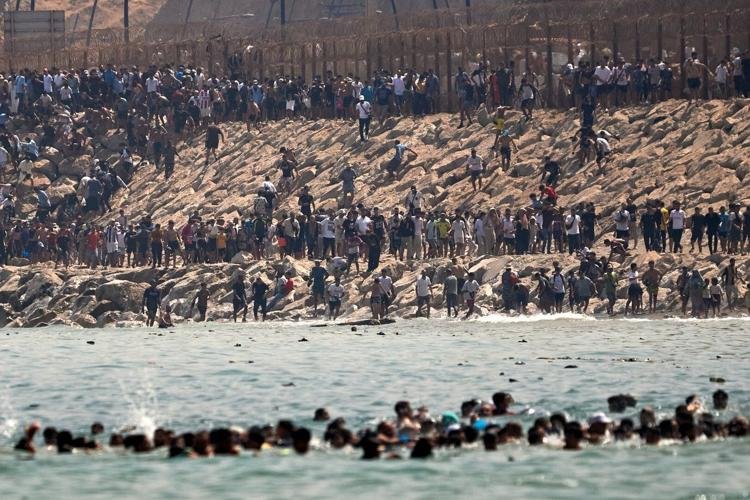
Thousands of migrants crossed into Spain’s North African enclave of Ceuta this week. Many swam around the border fence from Morocco. The sudden surge has overwhelmed local authorities and triggered a political storm across Europe.
Local leaders in Ceuta have asked Madrid to declare a state of emergency. The Spanish government responded by deploying troops to the territory. Officials say the army will reinforce security after days of crossings.
Migrants started crossing in large numbers on Wednesday. Videos of the crossings spread quickly on social media, drawing outrage from right-wing politicians across Europe. Germany’s AfD co-chair Alice Weidel said Ceuta was being “overwhelmed.” She noted more than 1,500 migrants, mostly from Morocco and Algeria, had breached the EU’s external border in a very short window.
The exact trigger behind Thursday’s sudden surge remains unclear. But on Wednesday, a group of migrants had already attempted to swim across the border, according to the Associated Press.
The timing also follows a ruling by Spain’s Supreme Court. That ruling restricts authorities from carrying out immediate deportations of migrants who arrive by sea. Critics argue the ruling weakened Spain’s ability to respond quickly to exactly this kind of surge.
Sánchez Faces Sharp Domestic Criticism
Spanish Prime Minister Pedro Sánchez called the situation a “serious crisis for Spain and for Europe.” He said the government “cannot look the other way on its obligations because we are facing a national security crisis.”
The opposition wasn’t impressed. Vox leader Santiago Abascal called the crossings an “invasion.” Alberto Núñez Feijóo, who heads the centre-right People’s Party, also criticized how the government has handled the situation on the ground.
Feijóo’s allies in Brussels backed him up. The European People’s Party said on X that the European Commission “must hold Sánchez accountable” for “failing to protect Spain’s external border.” The group added that Europe is “paying the price.”
Meloni Threatens to Cut Ties Under Schengen
Italy’s response has gone further than criticism. Prime Minister Giorgia Meloni said Rome stands ready to take “extraordinary measures” to protect its own borders. She specifically raised the option of suspending the Schengen open-border agreement with Spain.
Meloni also reaffirmed her government’s hardline stance on unauthorized migration. She said Italy will keep prioritizing border protection, cracking down on human trafficking networks, and carrying out swift deportations. Italian Foreign Minister Antonio Tajani echoed her position in a separate post.
The EU and Morocco Respond
European Migration Commissioner Magnus Brunner said he remains in constant contact with Spanish authorities. He stressed that protecting the EU’s external borders is “a crucial part of our efforts to fight illegal migration.” The European Commission has offered operational support through Frontex, the EU’s border agency.
Morocco insists it is cooperating with Spain and the EU to manage the arrivals. Spanish Civil Guard sources in Ceuta see it differently.
They say support from the Moroccan Gendarmerie has been limited and hasn’t done enough to ease pressure at the border, despite the Spanish government’s public insistence that cooperation remains active.
Spain and Morocco have since agreed on the urgent return of the latest arrivals, according to Euronews. How quickly that agreement translates into actual returns remains to be seen.
Echoes of 2021
The scenes out of Ceuta this week recall the 2021 migration crisis. Back then, around 10,000 people entered the enclave over just two days, after Morocco appeared to loosen its own border controls. That earlier surge came amid a diplomatic dispute between Madrid and Rabat over the Western Sahara region.
Ceuta has a population of roughly 85,000. Along with Melilla, it’s one of the few African territories Spain still holds, and one of just two places where the European Union shares a land border with Africa.
Both cities have long served as entry points for migrants trying to reach Europe, whether by climbing the border fence, swimming along the coast, or hiding in vehicles.
With troops now deployed and Italy openly floating a Schengen suspension, the coming days will test whether Spain and Morocco’s return agreement actually slows the crossings.
If it doesn’t, Sánchez faces mounting pressure from both his domestic opposition and EU allies who already blame him for the border strain.
How Brussels responds to Meloni’s threat, and whether Frontex support materializes quickly, could determine whether this stays a Spain-Morocco issue or turns into a wider EU standoff.

Curated news reports, in-depth analysis, and special features by India’s Opinion editorial team.