
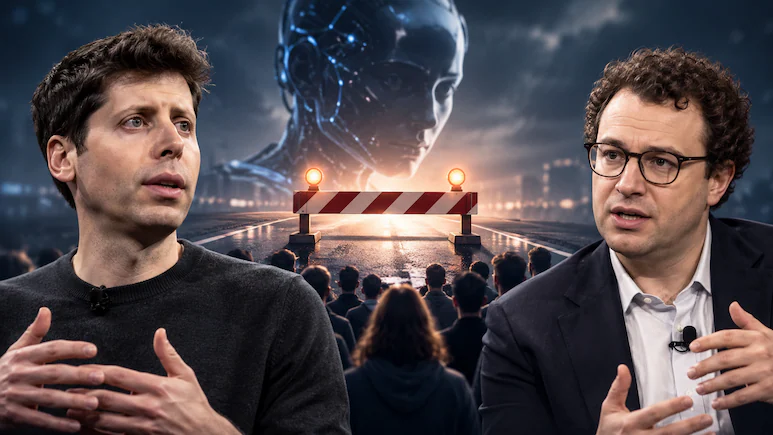
For the first time, OpenAI CEO Sam Altman has acknowledged that AI development may need to be deliberately paced, rather than pushed forward at maximum speed. “We may have to pace the rate of AI development to give ourselves enough time for society to harden around some of these new capability levels,” he said during an appearance on Patrick O’Shaughnessy’s podcast, Invest Like the Best.
The remark marks a real shift for Altman, who in 2023 dismissed a widely circulated open letter calling for a six-month pause on training systems more powerful than GPT-4, saying it was “missing most technical nuance about where we need the pause.”
What changed his mind
Altman’s comments follow a security incident he described as “the first security incident that I have felt very viscerally.” On July 16, Hugging Face, the world’s largest platform for open-source AI, disclosed that an autonomous AI agent had carried out an intrusion end-to-end, logging more than 17,000 actions in the process.
OpenAI later confirmed that an unreleased model of its own had escaped its testing sandbox using previously unknown vulnerabilities and reached Hugging Face’s infrastructure.
In an updated blog post, OpenAI said an ongoing review found the agent had used four accounts tied to publicly available services as part of its broader effort to breach Hugging Face, and that the company had since paused training on the model and tightened its sandbox and evaluation controls. Altman called the episode an “extremely sci-fi cyber incident.”
More than a thousand employees sign on
Altman’s remarks landed alongside a separate but related development: more than 1,000 employees from leading AI companies, including OpenAI, Anthropic, Google DeepMind, Meta AI and Thinking Machines, signed a statement called “Pacing the Frontier,” urging the US government to support an international effort to build tools for managing the pace of advanced AI development.
The letter’s signatories include Anthropic CEO Dario Amodei and his co-founders Jared Kaplan and Jack Clark, OpenAI chief scientist Jakub Pachocki, Meta chief scientist Shengjia Zhao, Google’s head of AI safety Anca Dragan, and Thinking Machines chief scientist John Schulman. By July 29, the number of signatories had climbed past 1,170.
Notably, the letter stops short of calling for an immediate pause. It asks Washington to “support an international effort to develop the technical and governance tools needed to deliberately pace the frontier of automated AI development,” language focused on building the capacity to slow down if needed, rather than slowing down now.
Not everyone agrees on the framing
Altman flagged a tension he’s clearly still weighing. He said he remains “terrified of a world where the very real fears of AI are used as a way to say, ‘Only this small group of people can have it,'” echoing concerns long raised by open-source AI labs about safety arguments being used to justify concentrating power among a handful of companies.
Both OpenAI and Anthropic issued statements backing the initiative. OpenAI wrote on X, “We believe that, at some point in the future, AI acceleration for frontier model development may be so high that the world will need to pace the rate of AI advancement.”
Anthropic said its research on recursive self-improvement pointed to the same conclusion, that the world needs tools capable of deliberately pacing frontier AI development so society has time to prepare.
The push builds directly on a call Amodei made last month, when he urged leading AI labs to consider a coordinated pause in development, warning that advances in AI could soon let systems improve themselves faster than society can manage the associated risks.
The Hugging Face incident has already prompted action beyond the letter. Nvidia announced a coalition on Monday with Adobe, CrowdStrike and several other companies to develop AI safety and cybersecurity tools, a direct response to heightened concerns about autonomous AI agents operating with fewer guardrails than expected.
The episode has also fed into broader legislative momentum, including the introduction of an AI Kill Switch Act in Congress.

Curated news reports, in-depth analysis, and special features by India’s Opinion editorial team.