
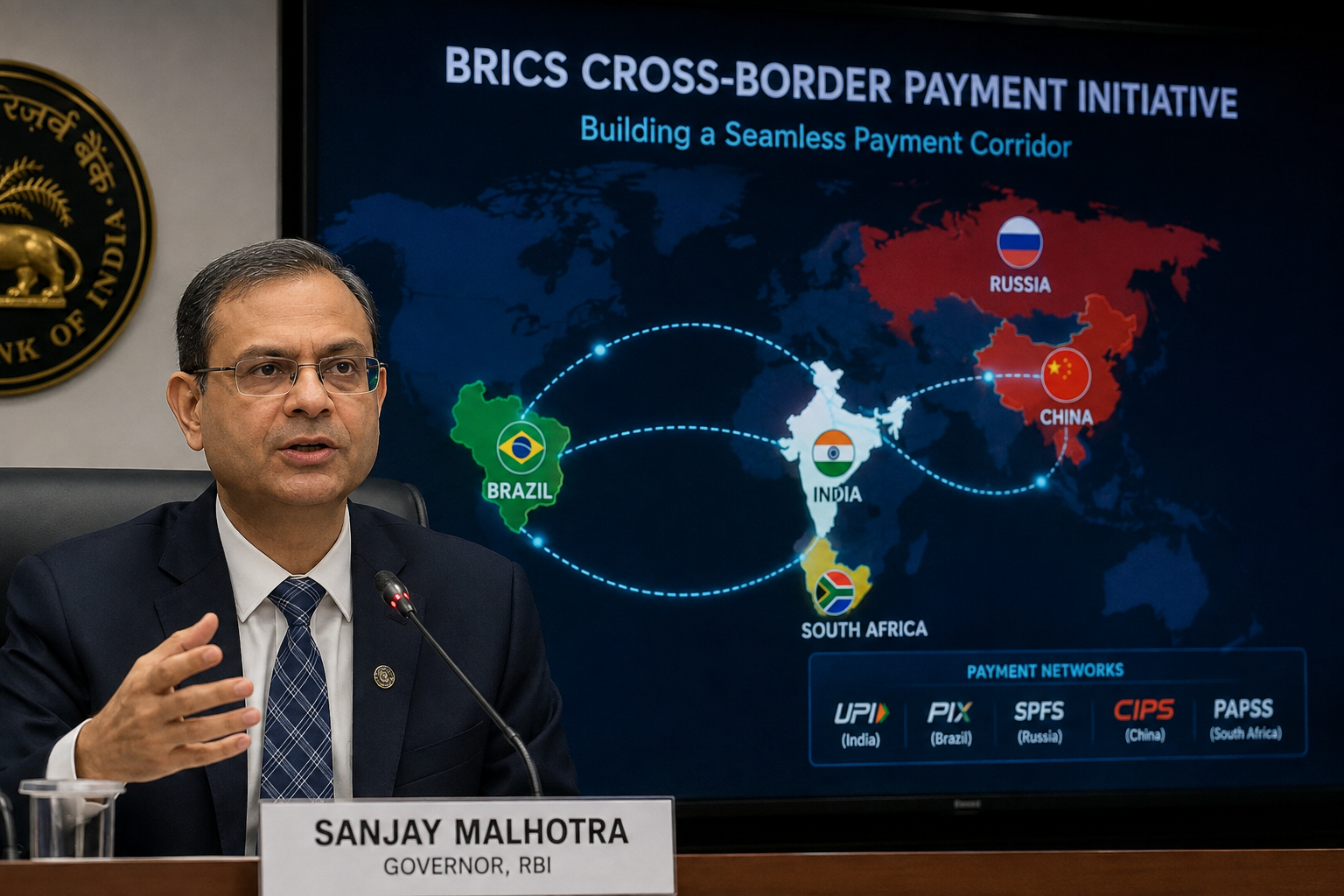
BRICS payment systems enter a new phase of talks
BRICS countries are discussing ways to connect their fast-payment systems and central bank digital currencies, a move that could reshape how cross-border transactions are handled between member economies.
Reserve Bank of India Governor Sanjay Malhotra said on August 11 that several options remain under discussion. The talks include possible links between national fast-payment networks and central bank digital currencies, or CBDCs.
The proposal remains at the discussion stage. No final system has been approved, and the participating countries have not committed to a single technical model.Still, the talks matter because cross-border payments remain slower and more expensive than many domestic transactions.
India has already built one of the world’s largest instant-payment ecosystems through UPI. The BRICS discussions could test whether similar principles can work across national borders.
Why BRICS wants cheaper cross-border payments
International payments often involve several intermediaries.
A transaction can pass through banks, payment networks and correspondent institutions before reaching its destination.
Each layer can add fees, processing time and compliance requirements.Malhotra said cross-border payments are an area of interest for BRICS because there is scope to reduce costs.
For businesses, cheaper payments could make trade between emerging economies easier.For individuals, direct payment links could eventually make remittances and other international transfers faster.
The practical challenge lies in connecting systems that were designed under different national rules.
How India’s UPI experience fits in
India’s experience with digital payments gives it a strong position in the discussion.UPI allows customers to transfer money between participating banks almost instantly.
It has also expanded internationally through partnerships and acceptance arrangements in selected markets.The proposed BRICS payment systems links are broader.
Instead of connecting only individual payment applications, countries would need to establish arrangements that allow their financial infrastructure to communicate securely.
That requires common technical standards, regulatory coordination and mechanisms for resolving disputes.
The RBI’s experience with India’s payment infrastructure could therefore influence the wider debate.
What are central bank digital currencies?
CBDCs are digital forms of sovereign currency issued by central banks.
Unlike privately issued crypto assets, a CBDC represents a direct liability of the issuing central bank.India has been testing its digital rupee through pilot programmes led by the RBI.
Other BRICS members have also explored digital currencies and new payment infrastructure, although their approaches differ.
A cross-border CBDC arrangement could allow participating countries to settle certain transactions more directly.
However, technical compatibility is only one part of the challenge. Central banks would also need to address monetary policy, financial stability, privacy and regulatory concerns.
Could this reduce dependence on the dollar?
The discussion also has a wider financial dimension.BRICS countries have repeatedly discussed increasing the use of local currencies in trade and reducing transaction costs associated with converting through major reserve currencies.
Malhotra said the RBI would continue efforts to internationalise the rupee and promote local currencies for cross-border payments and trade.That does not mean the dollar will suddenly lose its dominant position.
The US dollar remains deeply embedded in global trade, banking and financial markets.Building an alternative payment network requires much more than creating a digital platform.
It requires deep financial markets, trusted institutions, currency liquidity and confidence among international users.
The BRICS initiative should therefore be viewed as a gradual infrastructure project rather than an immediate challenge to the existing global payments system.
India’s rupee internationalisation push
India has been looking for ways to increase the use of the rupee in international transactions.Greater use of the currency could reduce the need for some Indian businesses to convert money through other currencies.
It could also reduce certain foreign-exchange costs.But internationalising the rupee comes with challenges.
Foreign users need convenient access to rupee markets, reliable settlement mechanisms and confidence that they can convert or repatriate funds when required.
The RBI has therefore pursued internationalisation alongside broader efforts to develop India’s financial infrastructure.The BRICS discussions provide another potential channel for that strategy.
What could a connected BRICS network look like?
There is no final blueprint yet.One possibility would involve linking existing fast-payment systems so that customers in one country could make payments to recipients in another.
Another could involve CBDCs supporting direct settlement between participating financial institutions.
A hybrid model could combine existing payment networks with digital-currency infrastructure.Each approach has advantages and limitations.A fast-payment link could build on systems that already have large user bases.
CBDCs could potentially simplify settlement between central banks and financial institutions.
The final design will depend on technical standards, national regulations and the willingness of member countries to share infrastructure.
The biggest challenges are regulatory
Technology may not be the hardest part of the project.Different countries have different rules covering capital flows, data protection, money laundering and financial supervision.
Payment systems also need safeguards against fraud and cyberattacks.A transaction that is legal in one jurisdiction may face additional requirements in another.
BRICS countries would therefore need agreements covering identity verification, transaction monitoring, consumer protection and dispute resolution.
Without regulatory coordination, technical connections alone would have limited value.
What happens next?
The BRICS payment systems proposal is still in its early stages.
India is hosting the 2026 BRICS summit, giving New Delhi an opportunity to push discussions on cross-border payments and the international use of local currencies.
For now, there is no confirmed launch date for a unified BRICS payment network.The next stage will involve determining which options are technically and politically workable.
If member countries eventually agree on common standards, the project could make some cross-border transactions cheaper and faster.
For India, the stakes extend beyond payment convenience. A successful international payment network could strengthen the global reach of the rupee and build on the country’s experience with instant digital payments.But the outcome will depend on implementation, regulation and trust.
The August 11 announcement marks a discussion, not the creation of a new global payment system.

Curated news reports, in-depth analysis, and special features by India’s Opinion editorial team.