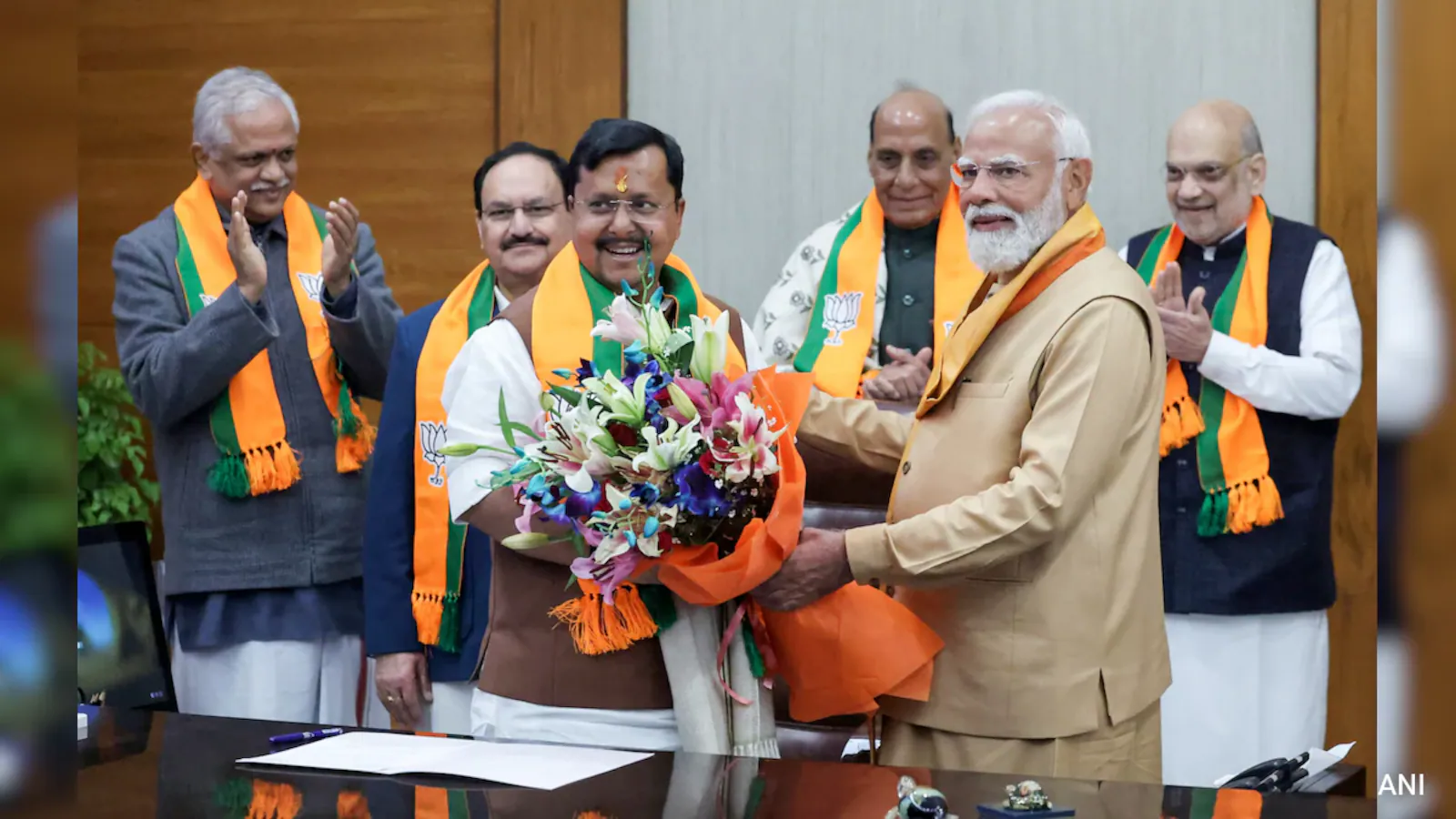
The BJP unveiled its new organisational team on Monday under national president Nitin Nabin, ahead of a run of state elections next year. The revamp puts a strong emphasis on regional representation. Additionally, it blends seasoned leaders with younger faces across key posts.
The headline move is the return of former Union minister Smriti Irani to a core organisational role, as one of the party’s national general secretaries. Irani had been rested from the Cabinet earlier. She had not held an active organisational post since.
Her comeback carries symbolic weight given her national profile. This was built in part on defeating senior Congress leader Rahul Gandhi in Amethi during the 2019 Lok Sabha elections.
Vasundhara Raje Returns Too, as Vice-President
Former Rajasthan chief minister Vasundhara Raje also finds a place in the new team. She joins the BJP as one of its 11 national vice-presidents. She’s listed alongside other vice-presidents including MP Baijayant Panda.
Reports ahead of the announcement had also flagged former Union minister Anurag Thakur as a likely returnee to the party’s national organisation. This move is part of a broader effort to bring back familiar, senior faces into active roles.
A Deliberate Push for Youth and Women
The reshuffle reflects a generational shift that party watchers had expected ever since Nabin, 46, became the BJP’s youngest-ever national president in January this year.
Ahead of the formal announcement, sources had indicated that 33 percent of positions in the new team, 13 of 38 posts, would be reserved for women.
The final list bears that out. Six of the 13 national vice-presidents are women. There are also four women secretaries and one woman general secretary. In addition, two secretaries from the Muslim community also feature in the team. This adds to the push for broader representation across the party’s core roles.
Regional Focus on the South and East
Beyond gender representation, the new team clearly leans into geography. Leaders from Kerala, West Bengal, Odisha and the northeast have been given prominent secretary and vice-president positions. This signals the BJP’s continued push to expand its footprint in southern and eastern states. These are regions where it has historically been weaker.
Where the New Team Sits in the BJP Hierarchy
The organisational structure above this new team remains anchored by the Parliamentary Board, the party’s highest decision-making body, chaired by Prime Minister Narendra Modi. It comprises Nitin Nabin, Rajnath Singh, Amit Shah, J.P. Nadda, former Karnataka chief minister B.S. Yediyurappa, Union minister Sarbananda Sonowal, BJP OBC cell chief K. Laxman, Punjab’s Iqbal Singh Lalpura, Haryana’s Sudha Yadav, Madhya Pradesh leader Satyanarayan Jatiya, and Karnataka’s B.L. Santosh, who also serves as general secretary (organisation).
Next in the hierarchy sits the Central Election Committee, also chaired by Modi. It includes all 12 Parliamentary Board members along with Maharashtra Chief Minister Devendra Fadnavis, Union minister Bhupender Yadav, and BJP Mahila Morcha chief Vanathi Srinivasan.
Below that sit the 11 vice-presidents (including Raje and Panda), seven general secretaries, one joint general secretary, and 11 secretaries. This is the layer where Irani’s appointment and the bulk of Monday’s youth and women representation actually lands.
Why Now?
The timing of this organisational reset is no accident. The BJP is preparing for assembly elections due in Uttar Pradesh, Uttarakhand, Punjab, Goa and Manipur early next year. Himachal Pradesh is due to follow later in 2027.
A younger, more diverse organisational team is widely seen as part of the party’s strategy heading into that cycle.
There’s also a more immediate political backdrop. The reshuffle comes in the aftermath of the student-led protests over irregularities in the NEET-UG examination, centred at Jantar Mantar in New Delhi. This ultimately forced Dharmendra Pradhan to resign as Union Education Minister.
Party observers see the new team’s emphasis on youth representation as at least partly a response to that wave of Gen Z-led unrest.
What Happens Next
With Nabin’s team now in place, its first real test will be how effectively it translates fresh faces and regional outreach into results across the string of state elections coming up in 2027. Whether Irani and Raje’s return signals a broader trend of rehabilitating sidelined senior leaders, or a one-off recalibration ahead of a tough electoral map, will likely become clearer as campaigning ramps up in the coming months.

Curated news reports, in-depth analysis, and special features by India’s Opinion editorial team.