
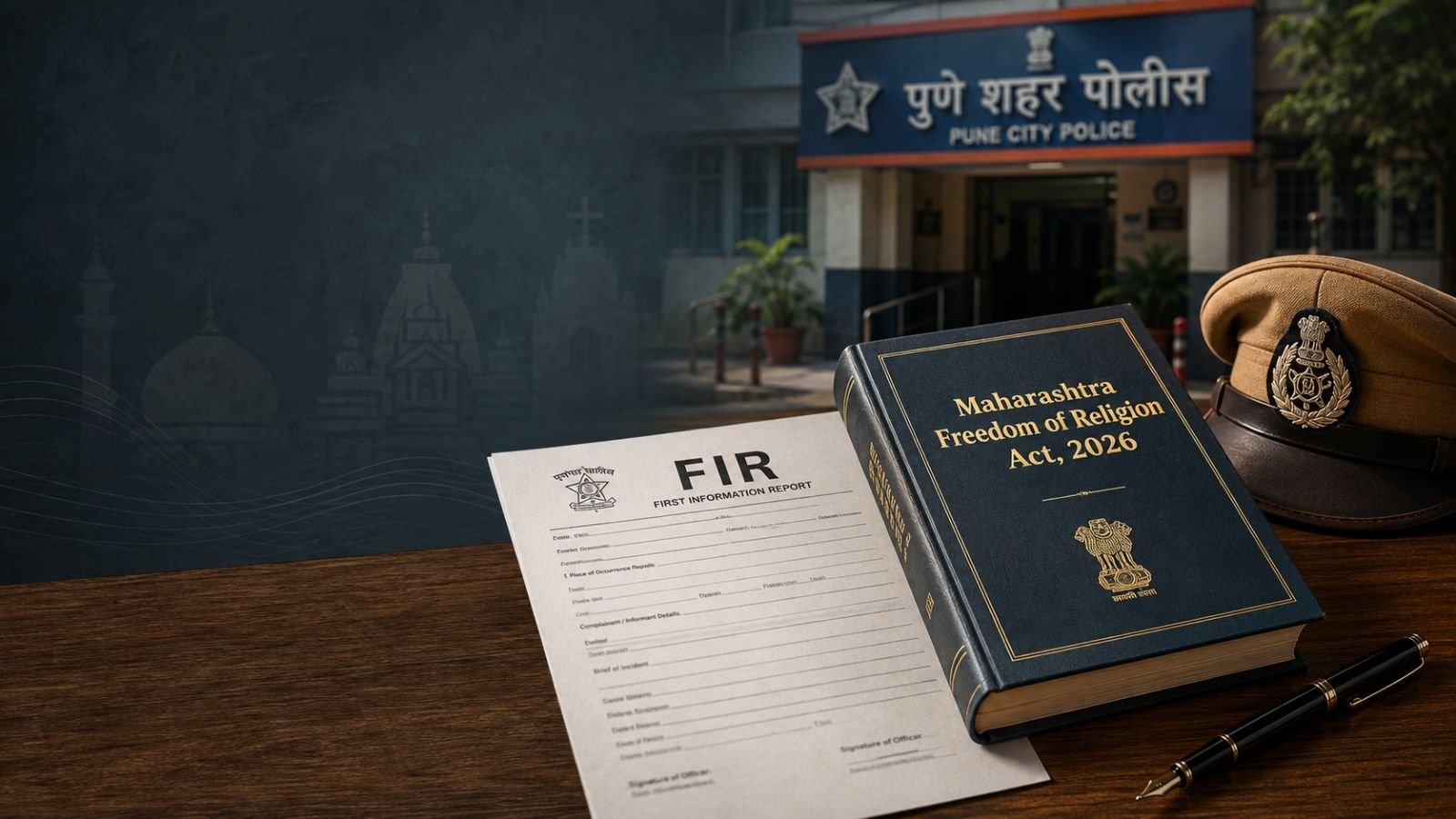
Pune city police registered the first FIR under Maharashtra’s newly enacted anti-conversion legislation. Investigators booked a 22-year-old man from Uttar Pradesh after he allegedly pressured a minor girl in a relationship with him to convert her faith. Consequently, law enforcement officers arrested the suspect and remanded him to judicial custody.
The legal action comes days after the state government officially notified the Maharashtra Freedom of Religion Act, 2026, on July 31. The new law strictly penalizes religious conversions carried out through force, coercion, undue influence, fraud, misrepresentation, or marriage promises.
Allegations Involve Inter-State Travel and Coercion of a Minor
According to police officials, the accused and the minor girl hail from the same village in Uttar Pradesh. The two entered into a relationship and subsequently traveled together through Karnataka before settling down in Pune.
However, conflict escalated when the man repeatedly demanded that the minor convert to his religion. When the girl resisted, local authorities intervened and launched a formal investigation.
Senior Police Inspector Amol More confirmed that officers booked the accused under Sections 3 and 9(2) of the new Act.
Additionally, police invoked provisions of the Protection of Children from Sexual Offences (POCSO) Act due to the victim’s minor status.
Background: Legislative History and Political Debate
The Maharashtra Legislature passed the Freedom of Religion Bill earlier this year following intense debates in the Assembly. President Droupadi Murmu gave formal assent to the Bill, paving the way for its official notification.
The ruling Mahayuti coalition strongly supported the measure to curb fraudulent and forced conversions.
Conversely, Opposition parties including Congress, NCP (Sharadchandra Pawar), and the Samajwadi Party opposed the Bill, raising concerns over potential misuse.
With this enactment, Maharashtra joins states like Uttar Pradesh, Gujarat, and Madhya Pradesh in enforcing strict anti-conversion laws.
Under the new statutory rules, any individual intending to convert to another faith must submit a mandatory notice to the District Magistrate at least 60 days in advance.
Furthermore, the law places the burden of proof on the person conducting the conversion to demonstrate that the act was entirely voluntary.
Enhanced Penalties Under the 2026 Act
The Maharashtra Freedom of Religion Act, 2026 establishes stringent judicial penalties for statutory violations. Section 3 broadly prohibits any individual from converting, attempting to convert, or abetting conversion through threat, coercion, or financial allurement.
Standard first-time violations carry prison terms extending up to seven years. However, Section 9(2) mandates stricter punishments when an offense involves minors, women, or members of Scheduled Castes and Scheduled Tribes.
In these aggravated cases, offenders face up to seven years of rigorous imprisonment along with fines reaching up to ₹5 lakh.
Repeat offenders face sentences extending up to 10 years. Police authorities confirmed that technical and testimonial evidence continues to be gathered to substantiate the charges.

Curated news reports, in-depth analysis, and special features by India’s Opinion editorial team.