In 1979, shortly after seizing power in Iraq, Saddam Hussein set his sights on an unlikely ambition: turning Baghdad into a global filmmaking hub, something producer Lateif Jorephani recalled Hussein imagining as a kind of “Bollywood on the Tigris.” His first step was to commission a lavish, Hollywood-scale film that would tie his Ba’ath party to the nationalist uprising that had ended British colonial rule in Iraq decades earlier.
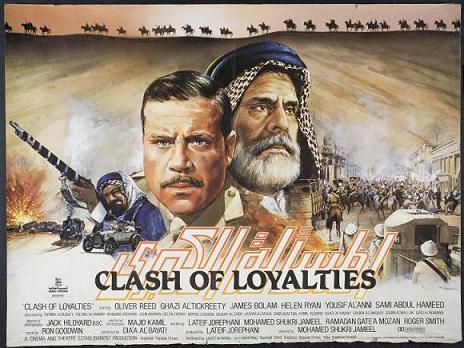
The result was Clash of Loyalties (also known as Al-mas’ala Al-Kubra, or The Great Question), a dramatisation of the 1920 killing of British officer Gerard Leachman near Fallujah during Iraq’s revolt against colonial occupation. One cast member later described it as Saddam’s answer to Lawrence of Arabia. Jorephani, an Iraqi-born British producer with decades of experience making low-budget films in the Middle East, was brought in by contacts within Hussein’s government. Thanks to the oil wealth flowing into Iraq in the 1970s, money was never an obstacle — Hussein’s simple instruction to his officials was to spend whatever the project required.
Production began in the desert outside Baghdad, but almost immediately ran into a historic complication: war broke out between Iran and Iraq just weeks after filming started in 1980. Despite this, the regime insisted the production continue as though nothing were wrong. Officials wanted to project an image of normalcy, assuring the crew the conflict would be resolved quickly. Filming paused only briefly before resuming.
Even so, the war’s presence was impossible to ignore. Cast members described their flight into Iraq being escorted by a fighter jet and landing without lights to avoid the risk of a missile strike. Local Iraqi actors were periodically pulled from the set for military service, sometimes with no warning, forcing scenes to be reshot. Logistics were also a nightmare: World War One-era prop weapons shipped from the UK were stopped at the Turkish border, where officials — insisting on their neutrality in the Iran-Iraq war — refused to believe the crates contained nothing but non-functional film props. The equipment ultimately had to be rerouted on a long detour through Greece, Lebanon, and Syria before finally reaching Baghdad.
Perhaps the most surreal incident involved a scene depicting the destruction of a munitions train supposedly ambushed by Iraqi rebels. Because the only suitable abandoned rail line was near the Iranian border, the staged explosion was picked up by Iranian media, who reported it as a real attack by Iran’s Revolutionary Guard on an Iraqi military train, claiming Iraqi soldiers had been killed — when in fact it was purely a film shoot.
Another cast member, actor Donald Sinden, ran into trouble after Iraqi security services asked him to hand over his personal holiday photographs, hoping they might reveal useful intelligence such as images of government buildings or communication towers. Instead, the photos led to Sinden’s own arrest, and he was taken in for interrogation by Hussein’s secret police. He managed to secure his release by pointing out that he was working on a film personally financed by Hussein, name-dropping a recent dinner with the dictator. He was allowed to leave the country the next day, still dressed in his 1920s-era military costume complete with pith helmet and pistol.
Despite these brushes with real danger, the production’s most serious crisis came from something far more mundane: the off-screen antics of its lead actor, Oliver Reed. After a night of heavy drinking, Reed urinated into an empty wine bottle in a hotel restaurant and had a waiter deliver it to a nearby table with his compliments. The stunt outraged Iraqi officials, and Jorephani received direct pressure from government ministers demanding Reed be removed from the production immediately. As the producer of an enormous, multi-million-dollar picture already deep into filming, replacing or losing his lead actor midway through would have been disastrous — potentially requiring the entire film to be reshot. Jorephani fought hard to keep Reed on the project and ultimately succeeded, though he described it as an intense struggle to convince the authorities to let the incident go.
By the time the film wrapped, production had stretched across three years and cost roughly $30 million — about $100 million (£76 million) in today’s money, a budget comparable to Return of the Jedi, released around the same era. Jorephani completed the editing process in London. But rather than achieving the international blockbuster success Hussein had envisioned, Clash of Loyalties had only a handful of screenings, winning an award at the Moscow Film Festival in July 1983. Beyond that, wider distribution never materialized, and the film was quietly shelved.
Hussein’s broader ambitions for a homegrown Iraqi film industry never got off the ground either. He had hoped this would be the first of a series of major international productions, but no others followed. After Iraq’s 1990 invasion of Kuwait triggered UN sanctions that lasted until Hussein’s fall in 2003, any chance of reviving the project or showing the film more widely disappeared entirely. In the end, Clash of Loyalties — a project built with an enormous state-backed budget and international ambitions — was seen by only a few hundred people before disappearing into film canisters stored in Jorephani’s garage in Surrey, England.
Reflecting decades later, Jorephani expressed some regret that the planned series of Iraqi-backed films never materialized, noting he might have gone on to make six or seven more pictures under the arrangement. But he also placed the experience in perspective, noting that after decades of war, destruction, and sectarian violence in Iraq, filmmaking setbacks felt insignificant by comparison — a strikingly modest verdict on one of the strangest and most expensive lost films in cinema history.

Curated news reports, in-depth analysis, and special features by India’s Opinion editorial team.