
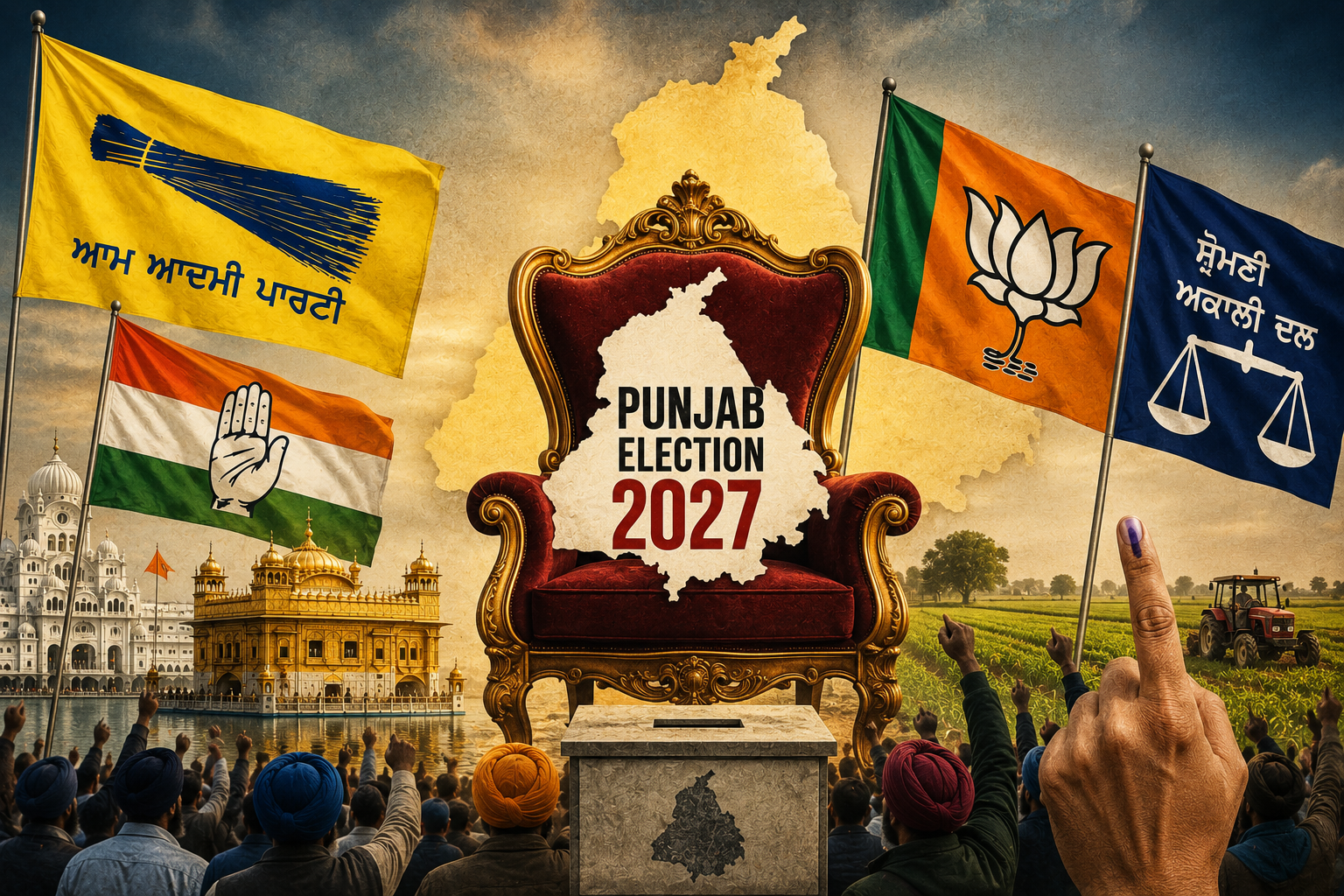
Punjab has often shaped India’s political story far beyond its geographical size. It led the Green Revolution, endured years of militancy, strengthened India’s food security, and produced generations of soldiers who have defended the country’s borders. Yet today, Punjab faces a different battle. It is fighting economic stagnation, rising debt, youth migration, unemployment and declining public confidence in political institutions.
The Punjab Assembly Election 2027 will therefore be about much more than choosing the next government. It will determine whether the state can find a new development model after years of economic and political uncertainty.
Unlike previous elections that revolved around anti-incumbency or identity politics, the next electoral contest is likely to focus on governance. Voters are becoming increasingly impatient with promises that fail to translate into visible improvements in their daily lives. Better jobs, quality education, industrial growth, safer communities and sustainable agriculture are expected to dominate public discourse.
The Aam Aadmi Party entered office in 2022 with one of the largest mandates in Punjab’s history. Riding on the promise of honest governance, better public services and an end to corruption, the Bhagwant Mann government generated enormous expectations. Over the past four years, the government has highlighted improvements in schools, healthcare facilities and anti-corruption measures while also expanding welfare initiatives.
However, elections are ultimately decided by public perception rather than government claims. Many voters continue to ask whether enough has been done to revive Punjab’s economy, create private-sector employment and attract fresh investment. Fiscal pressures remain significant, while industrial growth has struggled to match the pace of neighbouring states. As 2027 approaches, the AAP government will have to convince voters that its governance model has produced lasting structural change rather than isolated administrative successes.
For the Congress, the challenge is equally significant. The party retains a strong grassroots presence across Punjab and continues to command support among several rural and urban communities. Yet organisational unity remains its biggest obstacle. Leadership rivalries have repeatedly weakened its electoral campaigns and diluted its political messaging.
Punjab has historically demonstrated that dissatisfaction with the ruling government does not automatically translate into victory for the opposition. The Congress must present a united leadership, a credible chief ministerial face and a practical roadmap for economic revival if it hopes to return to power. Without organisational discipline, anti-incumbency alone is unlikely to deliver electoral success.
The Bharatiya Janata Party enters the election with a long-term rather than immediate strategy. Since its separation from the Shiromani Akali Dal following the farm laws controversy, the BJP has focused on expanding its independent organisational base. The party has invested considerable effort in strengthening its presence among urban voters, first-time voters and sections of Scheduled Caste communities.
Despite this expansion, converting organisational growth into a statewide electoral breakthrough remains a difficult task. Punjab’s political landscape has traditionally rewarded parties with deep local networks and strong regional leadership. The BJP’s performance in 2027 will therefore be closely watched as an indicator of whether it can emerge as a serious long-term force in the state.
Perhaps no political party faces greater uncertainty than the Shiromani Akali Dal. Once the dominant force in Punjab politics, the party has struggled to recover from years of declining public trust and organisational setbacks. The emergence of smaller Panthic organisations has fragmented the traditional Sikh political space, while younger voters increasingly prioritise employment, education and economic opportunity over conventional identity-based politics.
The Akali Dal’s future depends on whether it can successfully reinvent itself for a new generation of voters. Simply relying on historical legacy may no longer be sufficient in a state where political loyalties have become increasingly fluid.
Beyond party politics, Punjab’s greatest challenge remains its economy. Agriculture continues to support millions of families, yet rising input costs, declining groundwater levels, shrinking farm incomes and mounting debt have placed enormous pressure on rural households. Farmers continue to seek greater income security while simultaneously demanding diversification beyond the traditional wheat and paddy cycle.
At the same time, Punjab has struggled to attract the scale of industrial investment seen in neighbouring Haryana and Gujarat. Manufacturing hubs such as Ludhiana and Jalandhar continue to possess significant potential, but investors often point to infrastructure gaps, policy uncertainty and rising business costs. Reviving industry will require long-term policy stability rather than short-term electoral promises.
The state’s youth represent another defining electoral issue. Every year, thousands of young Punjabis leave for Canada, Australia, the United Kingdom and Europe in search of education and employment opportunities. While migration has long been part of Punjab’s social fabric, the growing perception that success lies outside the state reflects a deeper crisis of confidence in local economic prospects.
Political parties cannot address this challenge through welfare schemes alone. They must present a convincing strategy for job creation, entrepreneurship, skill development and investment that encourages talented young people to build their futures within Punjab.
The persistent problem of drug abuse also continues to shape public opinion. Every government has promised decisive action, yet many families believe the problem remains unresolved. Lasting progress will require stronger law enforcement, improved rehabilitation facilities, better mental health support and sustained community engagement.
As the election draws closer, digital campaigns, local governance and candidate credibility are likely to matter more than ever before. Punjab’s voters have repeatedly shown that they are willing to reject established political equations when they believe change is necessary. Electoral loyalty is increasingly conditional upon performance.
The Punjab Assembly Election 2027 is therefore not simply a contest between the AAP, Congress, BJP and Shiromani Akali Dal. It is a test of which political vision best addresses the structural challenges facing one of India’s most important states.
Punjab has overcome extraordinary challenges throughout its history. Its resilience has been tested by conflict, economic hardship and political instability, yet it has repeatedly found the strength to rebuild. The next election offers another opportunity to redefine the state’s future.
The party that succeeds in 2027 will not necessarily be the one with the loudest campaign or the sharpest slogans. It will be the one that convinces voters it has the credibility, competence and long-term vision to restore economic confidence, generate employment, modernise agriculture and rebuild trust in public institutions.
That is why the Punjab Assembly Election 2027 deserves to be viewed not merely as another electoral contest, but as one of the most consequential political moments in the state’s recent history.

Amrit Pandey is a political researcher and political communication professional specialising in elections, political behaviour and campaign strategy. He holds an MSc in Election Campaign and Democracy from the University of London and an MA in Data, Culture and Society from the University of Westminster.