Iran laid its slain Supreme Leader Ayatollah Ali Khamenei to rest on Thursday. The burial took place at the country’s holiest shrine in Mashhad. His son and successor, Mojtaba Khamenei, remained out of public sight. He was reportedly disfigured in the strike that killed his father.
The burial in northeast Iran capped a week of mass funeral processions. Rallies and mourning ceremonies had swept across the country. The events coincided with a fresh burst of conflict with the United States. This came after weeks of an uneasy truce.
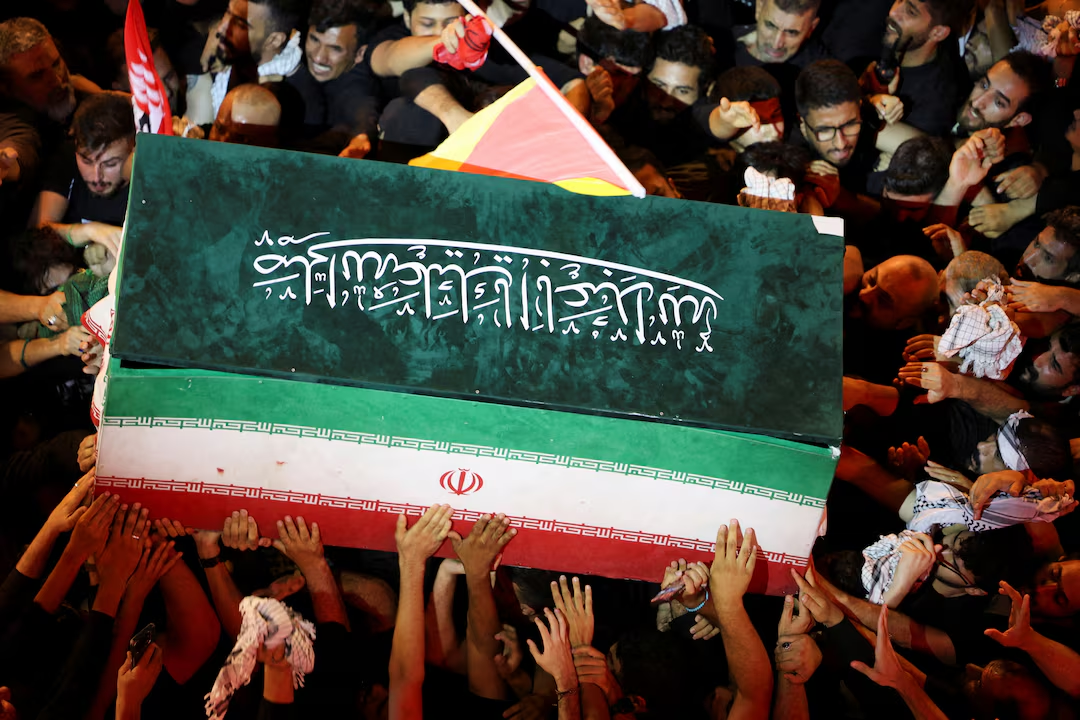
Khamenei’s body was carried by truck through the packed streets of Mashhad. The procession moved slowly toward the golden dome and minarets of the Shrine of Imam Reza. White-turbaned clerics walked on either side of the vehicle. Black-clad mourners pressed close behind.
Many waved Iranian flags and photographs of the late leader. Others carried red placards bearing revolutionary slogans.
The burial marked the final chapter of a week-long series of funeral events. These were held across both Iran and Iraq. The Islamic Republic’s clerical leadership encouraged massive turnout throughout the week.
The aim was to project the strength and ideological resolve of the theocratic state.
Iran has weathered a months-long military confrontation with the United States and Israel. Yet the country still faces steep internal challenges. Khamenei’s 37-year rule remains a deeply divisive legacy among Iranians.
Mojtaba Khamenei Still Missing From Public View
Mojtaba Khamenei was declared Supreme Leader by a clerical assembly a week after his father’s death. Despite the announcement, his whereabouts have remained unknown to the Iranian public.
He has not appeared publicly since the war began. The conflict started with the February 28 strike that killed his father. He has issued written statements since then. However, no image, video or voice recording of him has surfaced.
He reportedly suffered severe injuries in the same strike. His face was disfigured and his limbs badly wounded. Senior sources in Tehran say he is recovering.
He has not yet been well enough to handle public appearances. State security services are also said to be limiting his exposure. Officials reportedly fear the risk of further U.S. attacks.
Crowds Chant Threats Against Trump
Large crowds gathered in Mashhad ahead of Khamenei’s funeral cortege. Many chanted slogans calling for revenge against U.S. President Donald Trump. Mourners blamed him for the strike that killed their leader.
Some demonstrators held placards directly threatening the American president. Women in the crowd carried signs referencing his death.
The streets leading to the shrine were filled with black-clad mourners on Thursday. Many responded to chants praising Khamenei. Others repeated slogans condemning Iran’s adversaries. The old revolutionary chant “Death to America” echoed through the crowd once again.
Temperatures soared into the sweltering July heat as mourners waited for the coffins. Hoses sprayed water into the air above the crowd. The move was meant to help cool the massive gathering.
A Week of Mourning Across Iran and Iraq
Khamenei’s remains, along with those of four family members killed in the same strike, were paraded through multiple cities before Thursday’s burial. The procession passed through Tehran and the Shi’ite clerical centre of Qom. It also moved through the Iraqi shrine cities of Najaf and Karbala.
Each stop drew enormous crowds. Mourners gathered to the sound of mournful Shi’ite religious laments. Chants of revolutionary slogans accompanied the processions throughout.
Martyrdom holds deep significance in Shi’ite theology. Khamenei’s death at the hands of foreign adversaries has resonated strongly within this tradition. It reinforces a religious and political narrative long embedded in the Islamic Republic’s identity.
Khamenei’s Long Rule and a Disputed Legacy
The funeral arrives at a pivotal moment for Iran. It closes nearly four decades of Khamenei’s leadership. The timing also follows a wave of nationwide protests against the Islamic Republic in recent months.
Security forces crushed that unrest with force. The protests were fuelled by anger over an economy strained by international sanctions.
Thousands of demonstrators were reportedly killed in the crackdown. The violence echoed earlier waves of repression in past years.
Analysts note that Iran emerged from its recent war in a position of relative strategic strength. Tehran has maintained its grip over the strategically vital Strait of Hormuz.
Even so, the country has suffered extensive damage from the conflict. This has deepened existing economic troubles at home.
Ali Khamenei was appointed Supreme Leader in 1989. His rise came a decade after the Islamic Revolution. Over nearly four decades, he steadily consolidated political, economic and military authority within his office.
His growing power gradually sidelined Iran’s elected president and parliament. This shift was carried out in close coordination with the Islamic Revolutionary Guard Corps. The Guard’s influence expanded significantly throughout Khamenei’s rule.
Mojtaba Khamenei’s appointment as successor came with the backing of the Revolutionary Guards. The force is now widely viewed as the dominant power shaping Iran’s political and strategic direction going forward.

Jitendra Kumar is a graduate of the acclaimed IIMC with extensive experience across leading newspapers and media organisations.