
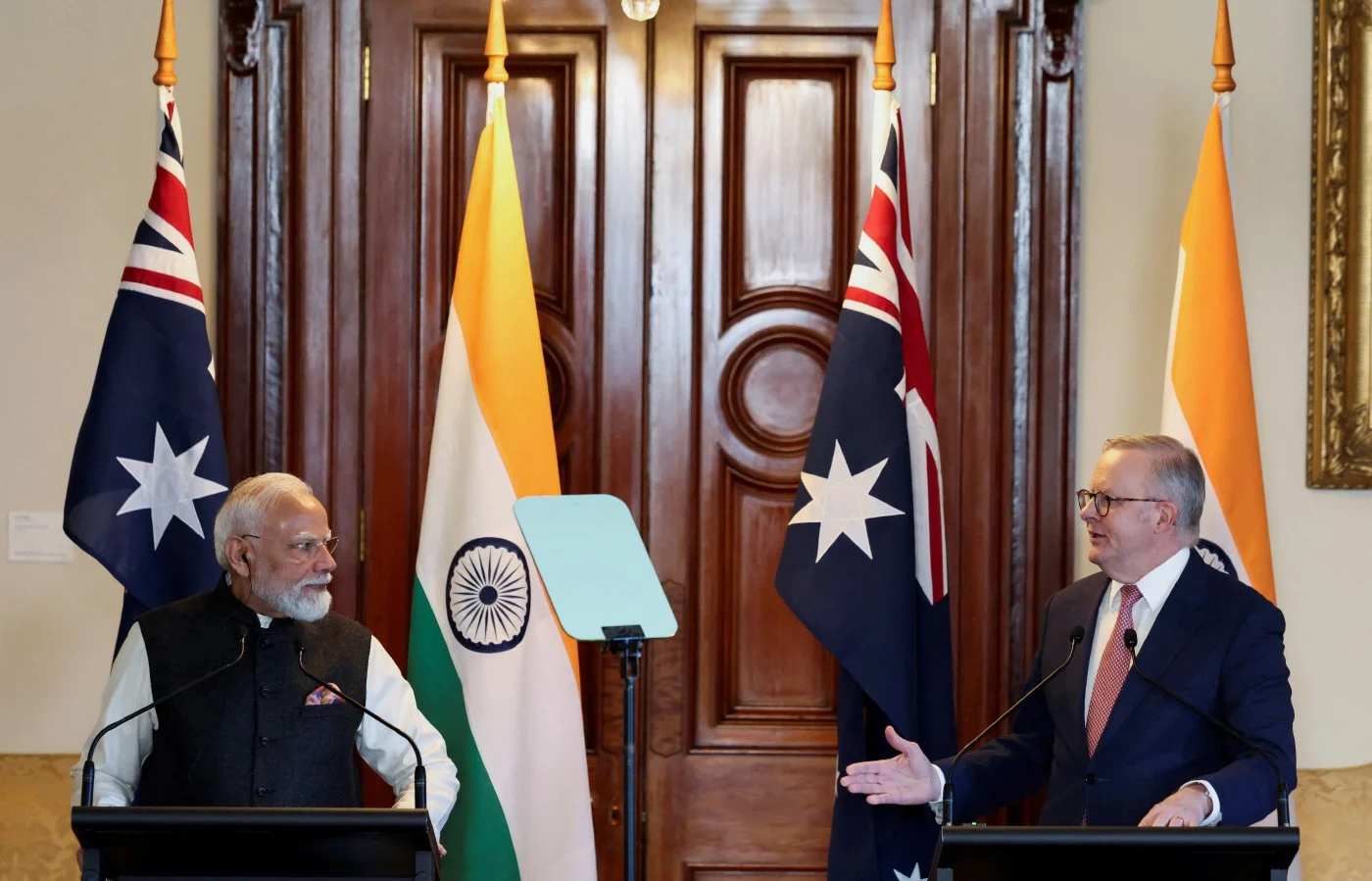
India and Australia signed a landmark civil nuclear agreement on Thursday. The deal will pave the way for commercial uranium supplies from Australia to India. It came alongside a series of other agreements covering defence, maritime security, critical minerals and emerging technologies.
Prime Minister Narendra Modi and Australian PM Anthony Albanese held wide-ranging talks in Australia. Following the talks, both sides unveiled a joint declaration on defence and security.
They also announced a roadmap for maritime collaboration and new partnerships in cyber, critical technologies and supply chains.
PM Modi called the nuclear agreement a key outcome of the visit. “Today, we have signed an important agreement in the field of nuclear energy,” he said. “This will open the way for uranium supplies from Australia to India and give new impetus to our clean energy objectives.”
The new administrative arrangement falls under the India-Australia Civil Nuclear Agreement. It will enable commercial supply of Australian uranium for India’s civilian nuclear power programme. The deal is expected to diversify India’s energy sources and strengthen long-term energy security.
It also supports India’s clean energy goals under the SHANTI Act — Safe and Holistic Advancement of Nuclear Technology for India. The Act aims to expand nuclear power capacity while ensuring safe and responsible use of atomic energy, according to details shared by the Ministry of External Affairs.
Albanese echoed the significance of the pact. “The arrangement facilitates Australian uranium exports to India to help increase the share of non-fossil fuel power capacity,” he said. He added that it also provides a new market for Australia’s resources sector.
The cooperation goes beyond nuclear energy. Both countries agreed to strengthen ties in critical minerals. PM Modi announced the launch of the Australia-India Partnership on Cyber, Critical Technologies and Supply Chains. Both sides also agreed to work together on a critical minerals corridor.
PM Modi highlighted the India-Australia Maritime Security Collaboration Roadmap. He said it would strengthen efforts toward a free, stable and rules-based Indo-Pacific. Both leaders reaffirmed their commitment to counter-terrorism cooperation. They also agreed to resolve global conflicts through dialogue and diplomacy.
The two leaders issued a joint declaration to deepen defence and security ties. Plans include stronger strategic coordination between the two nations.
They will also connect defence startups through the India-Australia Defence Innovation Corridor. The declaration further expands maritime cooperation and increases interoperability between their armed forces.

Curated news reports, in-depth analysis, and special features by India’s Opinion editorial team.