Meta’s decision to introduce usernames on WhatsApp could become one of the most consequential changes in the history of the world’s largest messaging platform. For nearly two decades, WhatsApp has operated on a simple principle: if you wanted to contact someone, you needed their phone number. That design choice, despite its limitations, created an important barrier against anonymity, impersonation and digital fraud.
That barrier is now about to disappear.
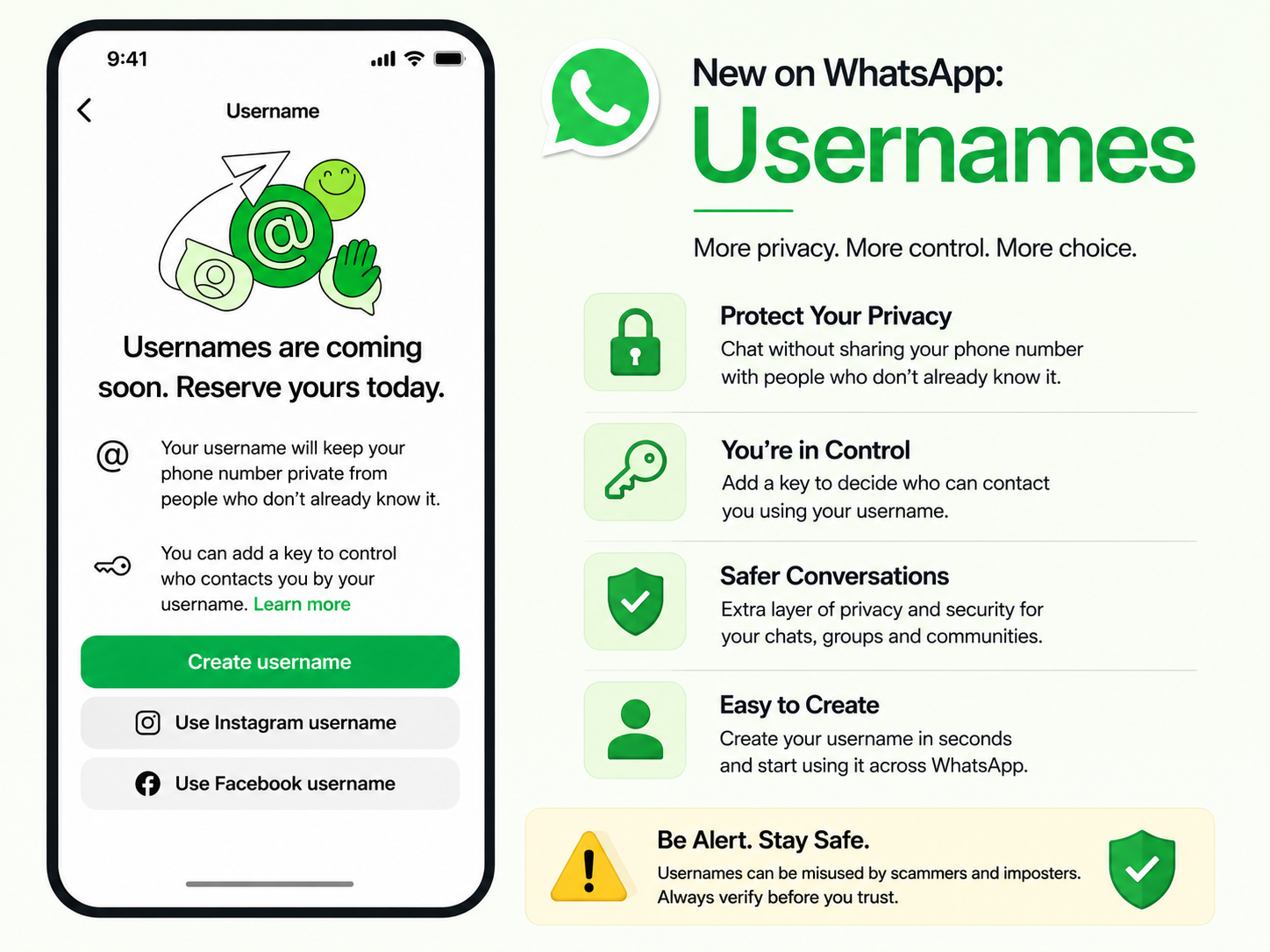
WhatsApp Username feature will allow users to create unique identities and communicate without revealing their phone numbers. The move brings WhatsApp closer to platforms such as Telegram, Signal and X, where usernames rather than phone numbers serve as the primary mode of identification.
According to Meta, the feature represents a major privacy enhancement. Users will be able to participate in conversations, groups and communities without exposing their personal mobile numbers. The company has indicated that usernames will be optional, non-searchable and protected by additional security measures, including optional username keys.
In theory, Meta’s argument is compelling. Privacy advocates have long argued that phone-number-based identity systems expose users to spam, harassment, surveillance and mass data harvesting. The ability to communicate without sharing personal contact information could prove especially valuable for women, journalists, activists, professionals and ordinary users interacting with strangers online.
However, the same feature that promises greater privacy may also create one of the biggest challenges related to digital fraud, impersonation and misinformation that India’s internet ecosystem has ever faced.
Why the Indian Government Is Concerned About WhatsApp Usernames
The Government of India’s decision to examine the legal implications of WhatsApp usernames is therefore not an overreaction. It reflects a fundamental reality of digital communication: privacy and trust often exist in tension.
Reports suggest that the Ministry of Electronics and Information Technology (MeitY) has sought explanations from Meta and is evaluating whether additional safeguards or regulatory interventions may be required before a wider rollout of the feature.
India is not simply WhatsApp’s largest market. It is arguably the world’s largest laboratory for digital communication. WhatsApp is used not only for personal messaging but also for banking, political campaigning, business communication, education, e-commerce and government outreach.
The introduction of usernames fundamentally changes how trust is established on the platform.
Until now, a fraudster attempting to impersonate a bank official, police officer or government representative had to overcome one important obstacle: the visibility of a phone number. That number often acted as a verification point, a warning signal or an investigative trail.
With usernames, identity can now be performed rather than merely presented.
How WhatsApp Usernames Could Increase Online Scams and Impersonation
Consider the possibilities:
- @SBI_Helpdesk
- @IncomeTaxIndiaSupport
- @UPPoliceService
- @PMO_Assistance
- @GovtSubsidyCentre
Even if Meta reserves usernames for prominent institutions and public figures, as it has indicated it intends to do, the history of social media suggests that impersonation rarely depends on exact duplication. Instead, it thrives on approximation.
A scammer does not require @SBI_Official if usernames such as @SBl_Official, @SBI_CustomerSupport or @SBI_HelpIndia can achieve the same outcome.
Platforms such as Telegram, Instagram and X have repeatedly demonstrated how lookalike usernames can be exploited for scams, misinformation and identity fraud.
This risk becomes especially serious in India, where digital literacy remains uneven and WhatsApp enjoys an extraordinary level of public trust. Millions of Indians already rely on WhatsApp for banking updates, government schemes, customer support, business transactions and political information.
Introducing pseudonymous identities into such an ecosystem could dramatically reduce the cost of fraud while simultaneously increasing the credibility of fraudulent actors.
WhatsApp Usernames and the Future of Political Campaigns in India
The implications extend far beyond financial crime. They could fundamentally reshape political communication and election campaigns in India.
For more than a decade, WhatsApp has served as the backbone of political mobilisation, voter outreach and narrative building. Political parties, volunteers, campaign workers and digital influencers rely extensively on the platform to organise supporters and influence public opinion. Research on Indian elections has consistently demonstrated that WhatsApp plays a central role in the spread of political information, rumours and misinformation.
The introduction of usernames could create an entirely new category of electoral risk: the weaponisation of identity itself.
Imagine an election campaign in which accounts using usernames such as:
- @ECI_Helpdesk
- @BJPCampaignDesk
- @CongressWarRoom
- @PMO_Update
- @ExitPollIndia
- @ElectionObserver
begin circulating messages across networks.
Even if such accounts are fake, many users may perceive them as legitimate, particularly when messages arrive through a platform that already commands exceptional levels of trust. The consequences could be profound.
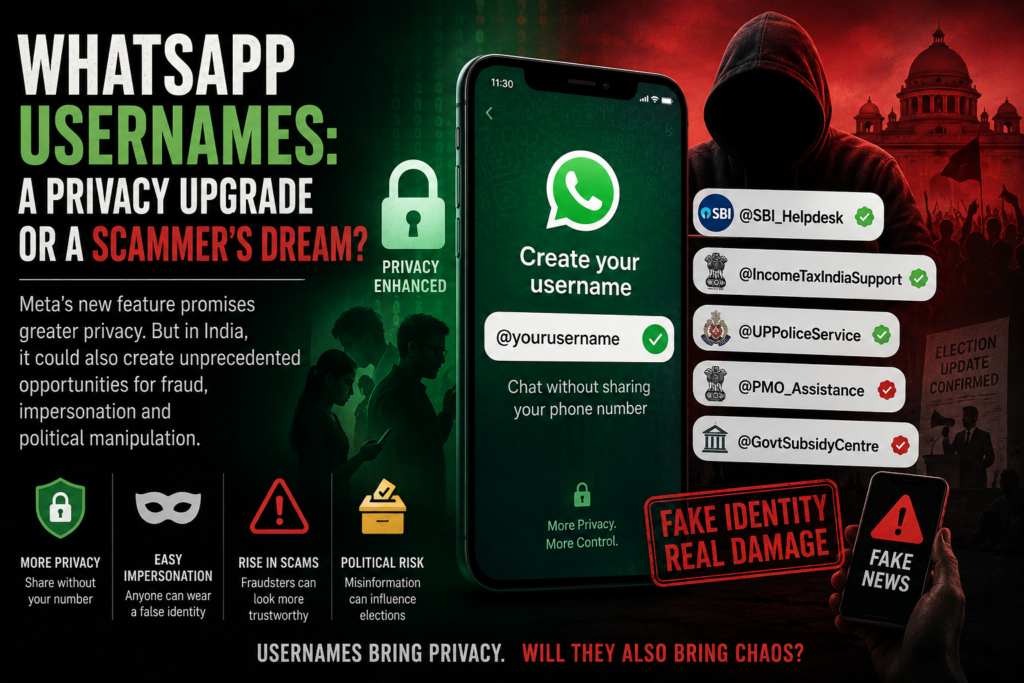
Fake election officials could distribute misinformation about polling dates or voting procedures. Impersonators could circulate fabricated statements attributed to political leaders. False endorsements, manipulated exit polls, forged campaign instructions and targeted voter suppression campaigns could spread rapidly through encrypted networks that remain difficult to monitor, verify or fact-check.
India has already witnessed how misinformation travels through WhatsApp groups and forwarding networks. Usernames introduce an additional challenge: malicious actors would not merely spread false information; they could impersonate trusted institutions and identities while doing so.
Can Meta Prevent WhatsApp Username Abuse?
To be fair, Meta appears to recognise these risks. The company has announced safeguards, including reserved usernames for public figures, the absence of a public username directory and additional privacy protections.
Yet history offers reasons for caution. Nearly every major social media platform has introduced identity-related features with assurances of safety, only to discover that malicious actors adapt faster than platform designers anticipate.
The Real Debate: Privacy vs Trust in the Digital Age
The debate surrounding WhatsApp usernames is not ultimately about technology. It is about trust.
Meta is correct that users deserve stronger privacy protections. The Indian government is equally justified in worrying that greater anonymity may facilitate fraud, impersonation and public deception. The challenge is not choosing between privacy and security. The challenge is ensuring that one is not achieved at the expense of the other.
If WhatsApp transformed political communication in India once through groups and message forwarding, usernames may transform it again through identity itself. The question is not whether WhatsApp usernames will change India’s digital ecosystem.