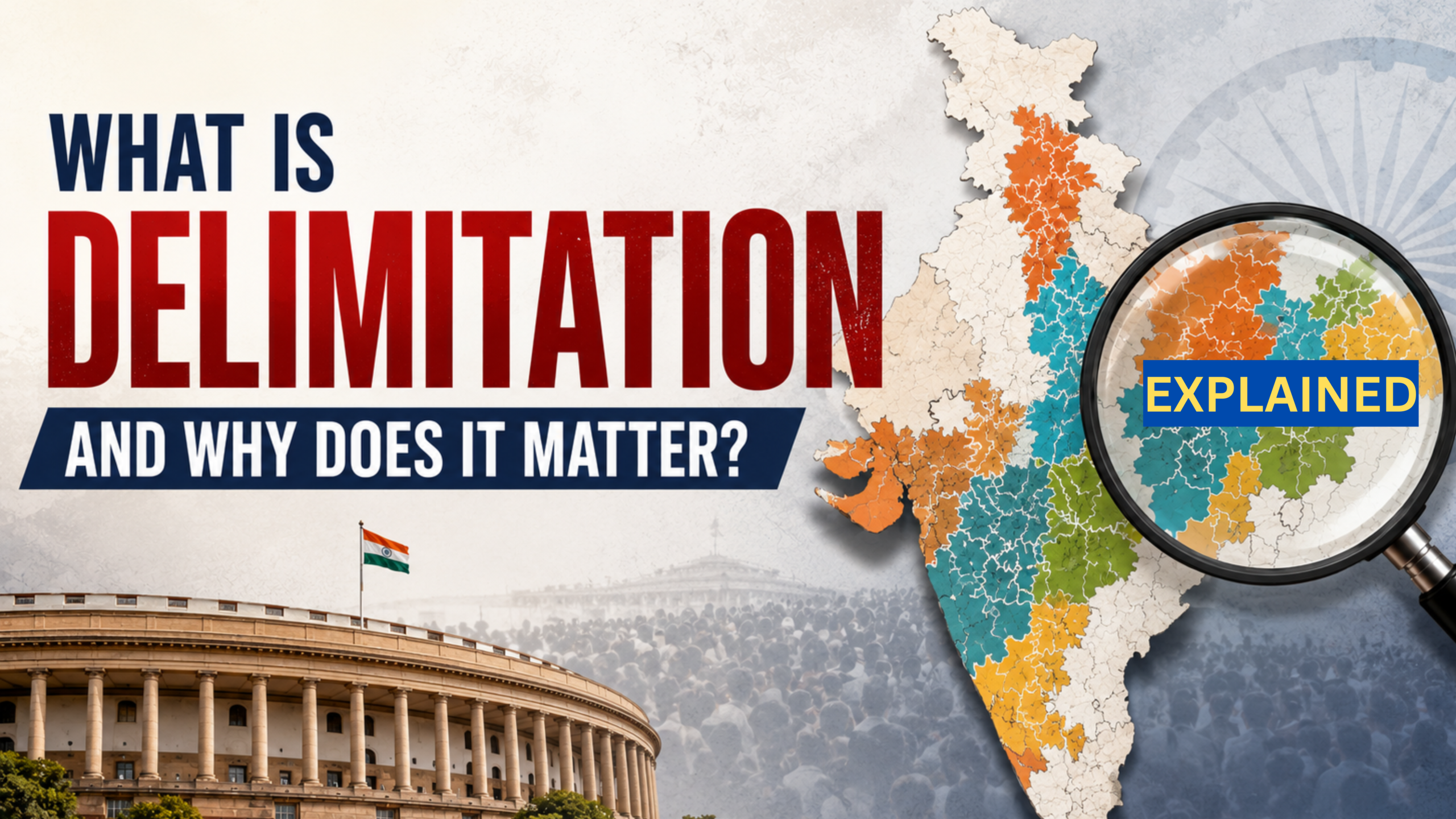
Delimitation is one of the most consequential yet least understood processes in Indian democracy. It determines how electoral constituencies are drawn, how many representatives each state sends to Parliament, and ultimately, whose voices carry greater weight in the country’s political system.
As India debates the possibility of a fresh delimitation exercise after the next Census, the issue has moved from being a technical administrative exercise to a major political and constitutional question. The outcome of delimitation could reshape the balance of political power between states, alter electoral strategies, and influence the future of Indian federalism.
What Is Delimitation?
Delimitation is the process of redrawing the boundaries of electoral constituencies based on changes in population. Its primary objective is to ensure that each elected representative represents roughly an equal number of citizens.
In India, delimitation applies to:
- Lok Sabha constituencies
- State Assembly constituencies
- Reserved constituencies for Scheduled Castes (SCs) and Scheduled Tribes (STs)
The principle behind delimitation is simple: as populations grow and shift over time, electoral boundaries must also change so that democratic representation remains fair and balanced.
Why Is Delimitation Necessary?
Population growth does not occur uniformly across the country. Some regions experience rapid population increases, while others witness slower growth or even decline.
Without periodic delimitation:
- Citizens in some constituencies may become underrepresented.
- Other constituencies may have disproportionately high political influence.
- The principle of “one person, one vote” becomes increasingly distorted.
For example, if one parliamentary constituency represents 15 lakh people while another represents 30 lakh people, voters in the smaller constituency effectively enjoy greater representation.
Delimitation attempts to correct such imbalances.
How Is Delimitation Conducted in India?
Delimitation in India is carried out by a Delimitation Commission established by the Government of India under an Act of Parliament.
The commission typically includes:
- A retired Supreme Court judge as chairperson
- The Chief Election Commissioner or a nominee
- State Election Commissioners of the concerned states
The decisions of the Commission have the force of law and generally cannot be challenged in court.
The commission uses Census data to redraw electoral boundaries and allocate seats.
How Many Times Has India Conducted Delimitation?
India has conducted delimitation exercises four times after Independence:
- 1952
- 1963
- 1973
- 2002
However, the 2002 exercise did not alter the number of seats allocated to states. It primarily redrew constituency boundaries based on population changes within states.
Why Was Delimitation Frozen?
One of the most important political decisions in India’s electoral history was the freezing of parliamentary seat allocation.
In 1976, during the Emergency period, the allocation of Lok Sabha seats among states was frozen until 2001. The rationale was to avoid penalizing states that had successfully implemented family planning policies.
The freeze was later extended through a constitutional amendment until 2026.
As a result, while India’s population has more than doubled since the 1970s, the distribution of seats in Parliament among states has remained largely unchanged.
Why Is Delimitation Becoming a Major Political Issue?
The possibility of a fresh delimitation exercise after 2026 has sparked intense political debate because population growth patterns across India have varied significantly.
Northern states such as Uttar Pradesh, Bihar, Rajasthan, and Madhya Pradesh have experienced relatively faster population growth.
In contrast, southern states such as Tamil Nadu, Kerala, Karnataka, and Andhra Pradesh have successfully reduced population growth through social development and family planning policies.
A fresh delimitation based strictly on population could therefore:
- Increase parliamentary representation for northern states.
- Reduce the relative political influence of southern states.
- Alter coalition politics at the national level.
- Change the balance of power within the Indian Union.
This is why many political leaders describe the upcoming delimitation exercise as one of the biggest political challenges facing India’s federal structure.
What Are the Arguments in Favour of Delimitation?
Supporters of delimitation argue that:
1. It strengthens democracy
Every citizen should have equal representation regardless of where they live.
2. It reflects current population realities
India’s demographic landscape has changed dramatically since the 1970s.
3. It improves electoral fairness
Constituencies with vastly different populations undermine democratic equality.
4. It enhances political accountability
Representatives can serve their constituents more effectively when constituency sizes are balanced.
What Are the Concerns About Delimitation?
Critics and concerned states raise several important objections.
1. States that controlled population growth may be penalized
States that successfully implemented family planning programs fear losing political influence despite achieving national development goals.
2. Federal balance could be disrupted
A major shift in parliamentary representation could alter India’s federal structure and intensify regional tensions.
3. Political polarization may increase
Changes in constituency boundaries can significantly affect electoral outcomes and political representation.
4. Resource allocation debates may intensify
Greater parliamentary representation often translates into greater political bargaining power.
Will the Number of Lok Sabha Seats Increase?
Many experts believe that future delimitation may involve increasing the total number of seats in the Lok Sabha rather than simply redistributing existing seats.
Expanding the size of Parliament could potentially reduce tensions between states by increasing representation while avoiding dramatic reductions in any state’s current political influence.
The construction of the new Parliament building, which can accommodate a larger number of MPs, has further fueled speculation about a future expansion of parliamentary seats.
Why Does Delimitation Matter to Ordinary Citizens?
Delimitation is not merely a constitutional or political issue. It directly affects citizens by determining:
- Who represents them in Parliament.
- The political importance of their state.
- The distribution of political power.
- Electoral competition and campaign strategies.
- The future shape of Indian democracy.
In many ways, it determines whose voices are heard most strongly in the world’s largest democracy.
Delimitation is far more than an exercise in redrawing electoral maps. It is a process that shapes political representation, influences federal relations, and determines the future balance of power in India.
As the country approaches the possibility of a fresh delimitation exercise after 2026, the debate is likely to intensify. The challenge for policymakers will be to balance democratic fairness, federal principles, and political stability.
