
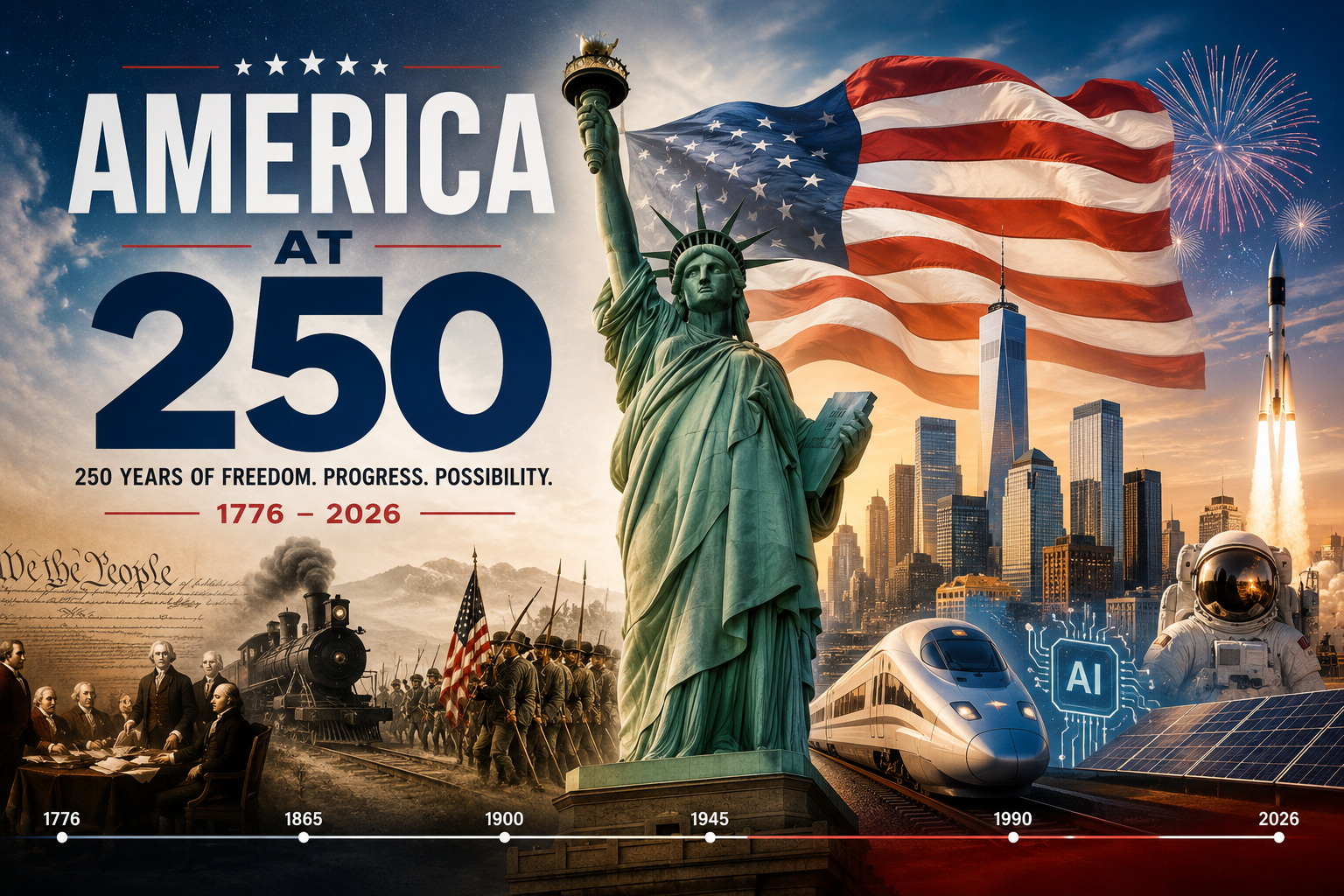
On July 4, 2026, the United States turns 250 years old. For a nation that often measures itself against ancient civilizations and empires that lasted centuries, even millennia, 250 years may not appear particularly long. Yet few countries in human history have transformed themselves, and the world around them, as dramatically as the United States has in the span of two and a half centuries.
When delegates of thirteen British colonies signed the Declaration of Independence in Philadelphia in 1776, they could scarcely have imagined the nation they were creating. The United States was then a narrow strip of settlements hugging the Atlantic coast, populated by fewer than three million people, lacking a standing army, burdened by debt, and facing the world’s most powerful empire. Today, it is the largest economy on Earth, the world’s foremost military power, the center of global finance and technological innovation, and arguably the most influential nation in modern history.
The story of America, however, is not merely one of extraordinary success. It is also a story of contradiction. The country that declared that “all men are created equal” tolerated slavery for nearly a century after its founding. The nation that championed democracy abroad often struggled to extend equal rights at home. The republic that promised limited government eventually built one of the most powerful states in human history. The American story has always been defined by this tension between ideals and reality, ambition and limitation.
The first century of the United States was largely a struggle for survival and expansion. Having secured independence from Britain through a costly revolutionary war, the young republic faced immediate questions about whether democracy itself could survive. At a time when monarchies dominated the world, the American experiment in representative government was viewed by many Europeans as fragile and temporary. Yet through the adoption of the Constitution in 1787 and the peaceful transfer of political power that followed, the United States established a political model that would influence nations far beyond its borders.
Territorial expansion transformed the country’s destiny. The Louisiana Purchase in 1803 doubled the nation’s size overnight. Waves of migration pushed American settlement westward, bringing prosperity, conflict, and profound moral questions. By the middle of the nineteenth century, the United States had become a continental power. But expansion also deepened divisions over slavery, culminating in the Civil War, the bloodiest conflict in American history.
The Civil War was more than a battle over territory or political authority. It was a defining struggle over the meaning of the American republic itself. The Union victory preserved the nation and abolished slavery, but the scars of that conflict would shape American politics and society for generations. In many ways, the United States that emerged after 1865 was an entirely new country: more centralized, more industrialized, and increasingly confident of its place in the world.
By the beginning of the twentieth century, America’s rise had become impossible to ignore. Industrialization transformed cities, railroads connected the continent, and waves of immigrants fueled economic growth on an unprecedented scale. Entrepreneurs such as John D. Rockefeller, Andrew Carnegie, and Henry Ford helped create the foundations of modern capitalism. By the outbreak of the First World War, the United States had become the world’s largest economy.
The two world wars completed America’s transformation from a rising power into a global superpower. The devastation of Europe and Asia after 1945 left the United States in an unparalleled position of strength. It possessed not only immense economic and military power but also the ability to shape the institutions that would govern the postwar world. The United Nations, the International Monetary Fund, the World Bank, and the broader architecture of globalization all bore the unmistakable imprint of American leadership.
The Cold War further cemented the United States’ global role. For nearly half a century, the competition with the Soviet Union drove advances in science, technology, military strategy, and diplomacy. The Moon landing in 1969 represented not merely a technological achievement but also a statement of national ambition and capability. When the Soviet Union collapsed in 1991, many believed that the American century had reached its ultimate triumph.
Yet America’s greatest contribution to the modern world may not have been military or political dominance. It may have been innovation. From the automobile to the airplane, from Hollywood to Silicon Valley, from the internet to artificial intelligence, the United States has repeatedly reshaped how people live, communicate, work, and imagine the future. Few societies have demonstrated a comparable ability to reinvent themselves through technology and entrepreneurship.
And yet, as America turns 250, the questions confronting the country are strikingly similar to those that have defined its history. How should political power be distributed? What does equality mean in practice? How should the nation balance security with liberty? What responsibilities accompany global leadership? And perhaps most importantly, what does it mean to be American in a rapidly changing world?
The story of the United States over the past 250 years is not simply the story of a country. It is, in many respects, the story of the modern world itself. Its triumphs, contradictions, ambitions, and failures have shaped global politics, economics, technology, and culture in ways that few other nations ever have.
As America enters its third century, its greatest challenge may not be preserving its power, but rediscovering the ideas that made its rise possible in the first place.

Curated news reports, in-depth analysis, and special features by India’s Opinion editorial team.